Best SDK Generators for 2027
Compare 5 SDK generators for 2027, including OpenAPI Generator, Fern, APIMatic, and Kiota, on languages, runtime features, custom code, and publishing.
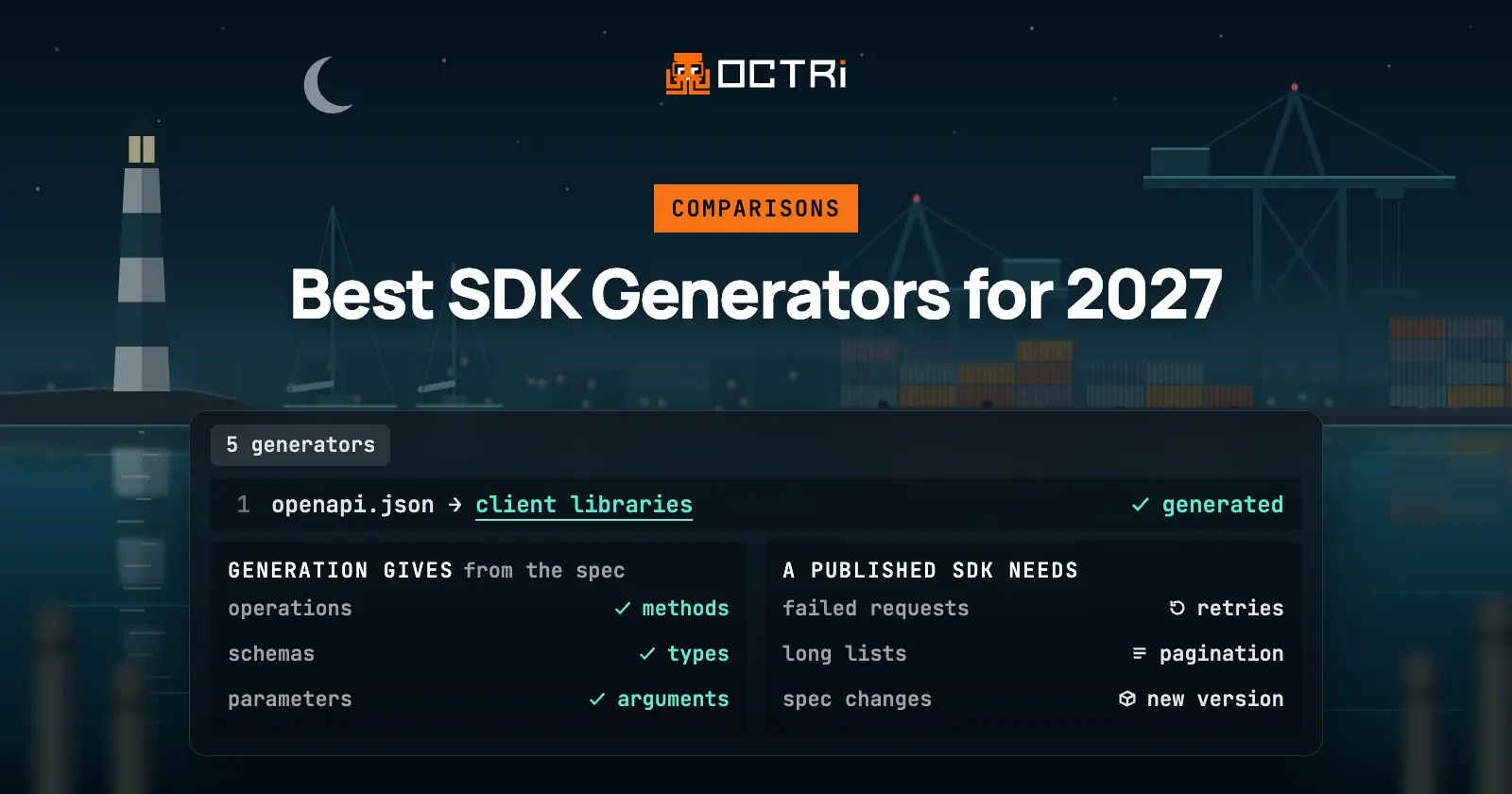
SDK generators turn OpenAPI specifications into client libraries that developers can install and use to call an API. We compared five SDK generation tools for 2027: Octri, OpenAPI Generator, Fern, APIMatic, and Kiota.
How we ranked the tools
Generating methods and types from an API specification is the starting point. A published SDK also needs to handle authentication, errors, pagination, retries, and streaming while providing an interface that feels natural in its language.
We evaluated each tool by language coverage, runtime behavior, control over the generated code, package publishing, and how SDKs stay current when the API changes. We gave substantial weight to the breadth of language targets and the ability to customize generated code, alongside the completeness of the publishing workflow. This accounts for OpenAPI Generator's second-place position through its generator catalog and template controls, while the release automation documented by Fern and APIMatic also contributes to their rankings.
1. Octri
Octri generates SDKs in ten languages from OpenAPI 3.0 and 3.1, Swagger 2.0, Postman collections, and AsyncAPI documents. The supported languages are TypeScript, Python, Go, Java, Kotlin, Ruby, PHP, Rust, Swift, and Dart.
You begin by uploading an OpenAPI file or connecting the repository containing it. Choose the languages you want to publish and assign a package name to each.
From there, SDK Studio lets you configure the public interface while previewing the generated code. You can choose between functions and a client class, group methods by tag or path, shorten method names, use objects or positional arguments, and adjust the folder structure.
Some settings are specific to individual languages. TypeScript can use fetch or axios, Python can use Pydantic or dataclasses, and Kotlin can use OkHttp or Ktor. The preview shows how these decisions affect the code developers will write.
The generated clients handle several behaviors that API consumers would otherwise implement themselves. Pagination uses a lazy iterator that follows the cursor, offset, page, or next-URL contract described by the API. Server-sent events are exposed through asynchronous iteration.
Errors have typed classes for common HTTP statuses, carrying the status code, response body, headers, and request ID. Requests retry on 408, 425, 429, and 5xx responses with backoff, and POST and PATCH requests carry idempotency keys. Webhook signature verification follows the Standard Webhooks specification.
SDK Studio can also generate a command-line tool with one command per API operation. Custom application logic lives in hooks that survive regeneration.
Each generated SDK repository includes a mock server built from the specification and contract tests that run against it. GitHub Actions formats, lints, compiles, and tests the package on every push and pull request.
The repositories belong to you. Octri publishes under your own accounts to npm, PyPI, Maven Central, RubyGems, Packagist, crates.io, and pub.dev. Go and Swift packages resolve through Git tags in their repositories.
When the specification changes, each SDK repository receives a pull request with a semantic version update. Breaking changes produce a new major version.
Generated clients also contain an error reporter that starts disabled. When an SDK user enables it, failures reach your Octri project with the SDK version, language, method, and HTTP status.
The same publishing process produces API documentation, monitoring, and an MCP server. A free plan supports generating and publishing an SDK in one language.
Octri leads the ranking because its workflow covers client customization, runtime behavior, testing, registry publishing, and versioned updates from the same API definition. See the available plans.
2. OpenAPI Generator

OpenAPI Generator is an open-source project that generates client libraries, server implementations, and supporting code from OpenAPI specifications. Its generator catalog currently lists 81 client generator targets, including multiple templates for individual languages.
The installation guide begins with the CLI. Install it using npm install @openapitools/openapi-generator-cli -g, then generate a client with a command such as npx @openapitools/openapi-generator-cli generate -i petstore.yaml -g ruby -o /tmp/test/.
The catalog covers languages including TypeScript, JavaScript, Python, Java, Kotlin, Go, Rust, Swift, Ruby, PHP, and Dart.
Runtime behavior depends on the selected generator. For example, typescript-axios uses Axios, while the Python generator supports urllib3, asyncio, httpx, and httpx2 library options. Request handling, error behavior, and other runtime capabilities follow the target's implementation and configuration.
Developers can shape the output through generator-specific options, custom templates, type mappings, and naming rules. TypeScript's Axios target, for example, supports generating one request-parameter object per operation through useSingleRequestParameter.
Generated package metadata can include registry names and versions. The resulting projects can enter existing build and publishing pipelines. OpenAPI Generator's Maven and Gradle plugins integrate generation into project builds. The Maven plugin runs the generate goal during a configured build phase, while the Gradle plugin exposes tasks including openApiGenerate, openApiGenerators, openApiMeta, and openApiValidate.
OpenAPI Generator takes second place for the number of client targets and the control available through templates and configuration. Octri leads under our publishing-focused criteria because generation, testing, registry releases, and version updates are coordinated within its SDK workflow.
3. Fern
Fern generates client libraries from API definitions through a shared SDK configuration. Its SDK documentation lists nine languages: TypeScript, Python, Go, Java, .NET, PHP, Ruby, Swift, and Rust. Kotlin and C++ are also listed, with access available by request.
The quickstart starts by installing the CLI with npm install -g fern-api. Initialize the project from an OpenAPI document using fern init --openapi path/to/openapi.yml, configure the target in sdk-config.yml, and run fern generate.
Fern's generated clients support retries with exponential backoff, pagination using offset, cursor, URI, and path-based schemes, OAuth token refresh, and server-sent events. These behaviors are part of its SDK generation capabilities.
Shared configuration defines authentication, retry behavior, and package details, while individual language targets control their respective generators. Custom code can be maintained through .fernignore, which protects handwritten files, or Replay, which reapplies edits during regeneration.
Fern supports publishing SDKs to GitHub repositories and language package registries. Its Autorelease workflow, currently in early access, responds to API specification changes by regenerating SDKs, determining the version bump, and publishing releases. It can also open pull requests for review.
Fern places third because its SDK configuration and release automation connect generation with published packages. OpenAPI Generator holds the higher position in our ranking for its larger catalog of client generator targets and template-level customization.
4. APIMatic
APIMatic generates SDKs from API descriptions, including OpenAPI, RAML, and API Blueprint. Its SDK generation overview lists seven language targets: Python, .NET, Ruby, Java, PHP, TypeScript, and Go.
The CLI workflow begins with apimatic sdk generate. To generate and download a Python SDK as a ZIP, the documented command is apimatic sdk generate --language=python --zip.
APIMatic-generated clients support pagination, OAuth token refresh, configurable HTTP clients, custom errors, and server-sent events. Its retry implementation uses exponential backoff, with configurable retry conditions, intervals, and limits.
SDK output can be adjusted through code generation settings, including styling and synchronous or asynchronous methods. Custom code injection preserves handwritten logic when the SDK is regenerated.
For distribution, APIMatic provides a Publishing Center where teams configure package metadata and registry credentials. The apimatic sdk publish command then publishes SDKs to supported registries and can run through CI/CD.
Generation can also be integrated into CI/CD so changes to the API definition trigger updated client code.
APIMatic occupies fourth place because its workflow covers runtime functionality, customization, and registry publishing. Fern's shared language configuration and documented Autorelease process, including automatic version determination from specification changes, give it the higher position under our release-lifecycle criteria.
5. Kiota
Kiota is a Microsoft open-source command-line project that generates API clients from OpenAPI documents. Its overview lists seven supported languages: C#, Go, Java, PHP, Python, Ruby, and TypeScript.
The installation documentation provides the command dotnet tool install --global Microsoft.OpenApi.Kiota. From there, a developer can generate a client using kiota generate with an OpenAPI document, language, namespace, and output directory.
Kiota produces typed models and request builders that follow the resource hierarchy of an API. A generated client navigates resources through properties and request builders, while language-specific abstractions manage HTTP requests, authentication, and serialization.
The client experience documentation shows how these request builders handle resource access, collection queries, and response models. Runtime components are assembled through the generated client's supporting libraries.
Developers control the generated surface with options such as --include-path, --exclude-path, --class-name, and --namespace-name. This allows a project to generate clients for selected API paths and control the naming of its client types.
Generated code is included in the language project's build and package workflow. Kiota writes a kiota-lock.json file containing generation settings and a specification hash. The kiota update command uses these lock files to regenerate clients. Microsoft's installation guide also documents a GitHub Actions workflow using microsoft/setup-kiota to automate client updates.
Kiota closes the ranking with a workflow centered on resource-oriented request builders, selective path generation, and repeatable updates through kiota-lock.json. Our ordering gives greater weight to language target breadth, generated package customization, and the publishing-related capabilities documented across the four preceding tools.
Questions to settle before publishing an SDK
How should you prepare an OpenAPI specification for generation?
Check operation IDs, response schemas, references, and authentication definitions before generating. An operation such as post_v1_orders_create can produce an awkward public method name, while a missing response schema can weaken the return type. The SDK generation guide explains how these specification details become methods, arguments, and models.
Where should custom behavior live so it survives regeneration?
Start with the API definition for naming and schema changes. Use a versioned OpenAPI Overlay when the original document belongs to another team, and a request hook when behavior depends on the final serialized request. The customization guide explains where to place each type of change and how to keep it reproducible.
What should you test beyond compilation?
Use a mock transport to verify the exact HTTP method, URL, headers, and body sent by the client. Exercise errors, retries, and pagination, then run documented code examples against the built package. The SDK testing guide includes examples that check request construction and verify that retries preserve the same idempotency key.
Which package details should be decided before the first release?
Check package-name availability across the registries you intend to use. PyPI normalizes underscores and hyphens, Maven Central requires verification of the domain associated with your group ID, and Go module paths depend on repository locations. The package publishing guide explains these constraints and the decisions that become difficult to reverse after publication.
From generated code to published SDKs
An SDK becomes part of another developer's application. Once a package is installed, its method signatures, response types, error behavior, and dependencies become part of that application's codebase. A change to the original API specification can therefore have consequences well beyond the generated repository.
The release process needs to account for those consequences. Generation, contract testing, versioning, and publishing all contribute to the interface developers eventually install. Our guide on how to choose an OpenAPI SDK generator explores those considerations in more detail.
Octri's OpenAPI SDK generator brings these steps into SDK Studio, where you can shape the client, preview its code, and publish language packages from the same API definition used by your documentation, monitoring, and MCP server.