By the Octri team · Updated
How to generate an SDK from OpenAPI: a step-by-step guide
OpenAPI can describe an API precisely enough for software to produce a client library. The attraction is obvious: when an endpoint changes, you update a spec rather than hand-editing every language. The catch is that a generator is literal-minded. It will reproduce a poorly named operation or a missing response schema as faithfully as it reproduces a good one.
How do you generate an SDK from an OpenAPI spec?
Validate the document and resolve references, decide which operations belong in the public client, configure package names and language-specific conventions, then generate. Compile, test and inspect the result before publishing. Put the process in CI so the next spec change follows the same path instead of relying on someone to remember a manual step.
The generation command is usually the shortest step. Preparing an accurate contract and reviewing the public interface take longer.
What a generator does with each part of the spec
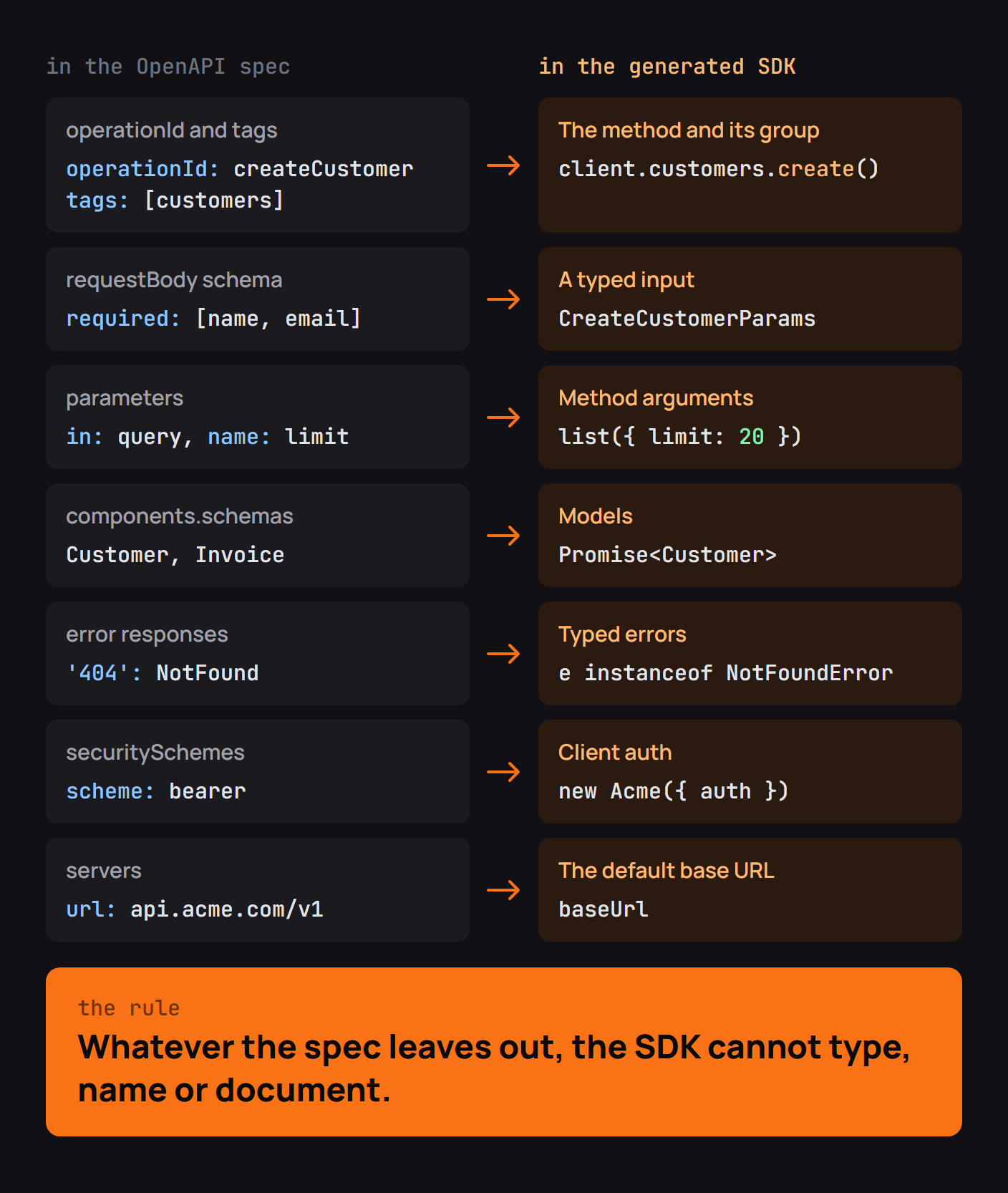
An operation becomes a method, and the details around it become its arguments and types. operationId provides a naming seed; tags group methods; parameters and request bodies become typed input; response schemas become return types; and security schemes inform client authentication. Descriptions often turn into editor hints or method docs.
paths:
  /orders:
    post:
      operationId: createOrder
      tags: [orders]
      summary: Create an order
      requestBody:
        required: true
        content:
          application/json:
            schema:
              $ref: '#/components/schemas/CreateOrder'
      responses:
        '201':
          description: Created
          content:
            application/json:
              schema:
                $ref: '#/components/schemas/Order'
This is an operation fragment, not a standalone complete spec. The referenced schemas and the document's OpenAPI version must exist for a real build.
Prepare the spec before you generate
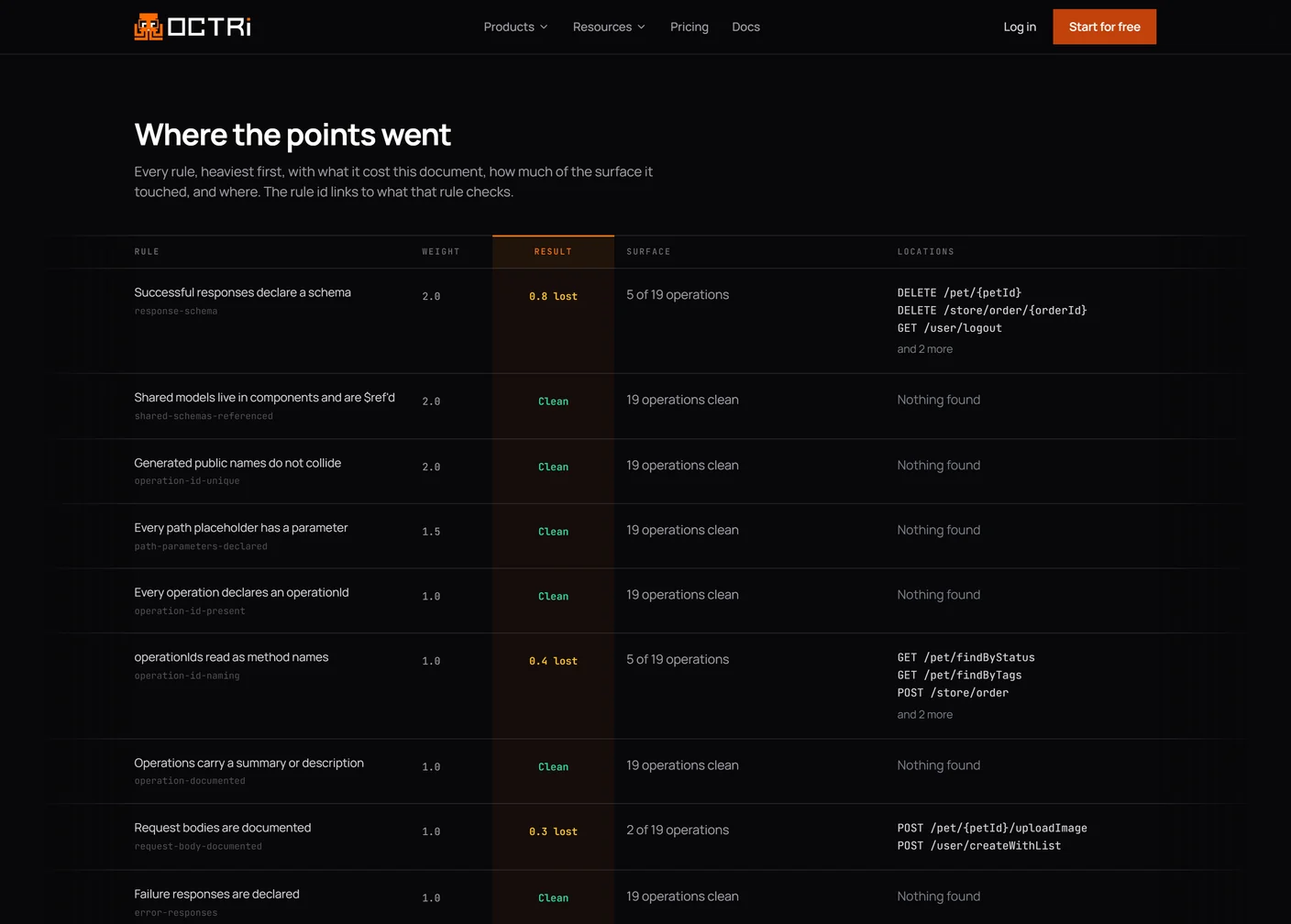
Validate syntax, but don't confuse a parsable document with a useful contract. Look for duplicate or unwieldy operation IDs, anonymous inline schemas, absent response bodies, missing errors and incorrect security definitions. A generated method with a vague return type is often a documentation problem in disguise.
I tried a tiny conversion test with an operation ID copied from a framework-style route name: post_v1_orders_create. The projected SDK method looked just as awkward. Changing the source name to createOrder fixed the projection without touching the generated method. The local test did not build a production library, but it captured the essential dependency: the interface will inherit the names the generator is given.
Ways to generate an SDK
A CLI can run locally or in CI. Hosted generators may offer interface previews, per-language tuning and publishing workflows. Some teams maintain their own templates because they need unusual language conventions or dependencies. Whatever the route, pin both the spec revision and the generator revision so a release can be reproduced.
Compare generated code on a realistic API with nested schemas, pagination, nullable fields, file uploads and error responses. A one-operation Petstore demo will not expose most production problems.
Generate in CI so the SDK follows the API
Make generation a consequence of a reviewed spec change. A practical sequence is: validate the spec, create language clients, format and compile, run contract and package tests, inspect the diff, then prepare a release. Do not publish on every arbitrary commit; publishing should follow a deliberate version policy.
OpenAPI change → validation → generation → tests → reviewed package releaseA no-op rebuild should produce no diff. If it doesn't, fix nondeterminism before it overwhelms reviewers with unrelated changes.
Test the generated SDK
Start with contract tests that ask whether the method sends the specified HTTP method, path, parameters, body and authentication. Then test missing optional fields, unknown enum values, non-JSON error bodies, connection failures and multi-page responses. An SDK can compile successfully and still send the wrong query parameter.
Run README snippets as tests too. A generated API reference can be accurate while a handwritten quickstart still uses last month's class name.
Publish and version the SDK
A package version describes the client library; an API version describes the service's contract. Record which release of each client corresponds to the API revision, and publish breaking changes with migration guidance. Before uploading, install the built package in a fresh project, import it and make a sandbox call.
Keep your own code when you regenerate
Place wrappers, hooks and workflow helpers in directories or extension points excluded from regeneration. Never rely on edits inside generated models surviving the next build. A strong generation pipeline gives the machine ownership of the mechanical surface and humans ownership of the design decisions.
Common problems when generating an SDK
Look for duplicated model names, unexpected any or object return types, a method group full of generic path names, incorrect nullable fields and HTTP transport defaults that don't suit the target language. Fix at the highest reliable level: spec, transform, generator configuration, template, then handwritten extension.
SDK generation checklist
Verify the spec, test a representative operation from each category, build each package, exercise a rate limit and a validation error, and check one regeneration with no changes. Read the generated README as a new user would. The finished product is a working client, not a directory of syntactically valid files.
Generating SDKs with Octri
Octri can take a machine-readable API description and produce SDKs with per-language customization and previews. Its OpenAPI audit can also help identify naming and schema gaps before they propagate to every package.
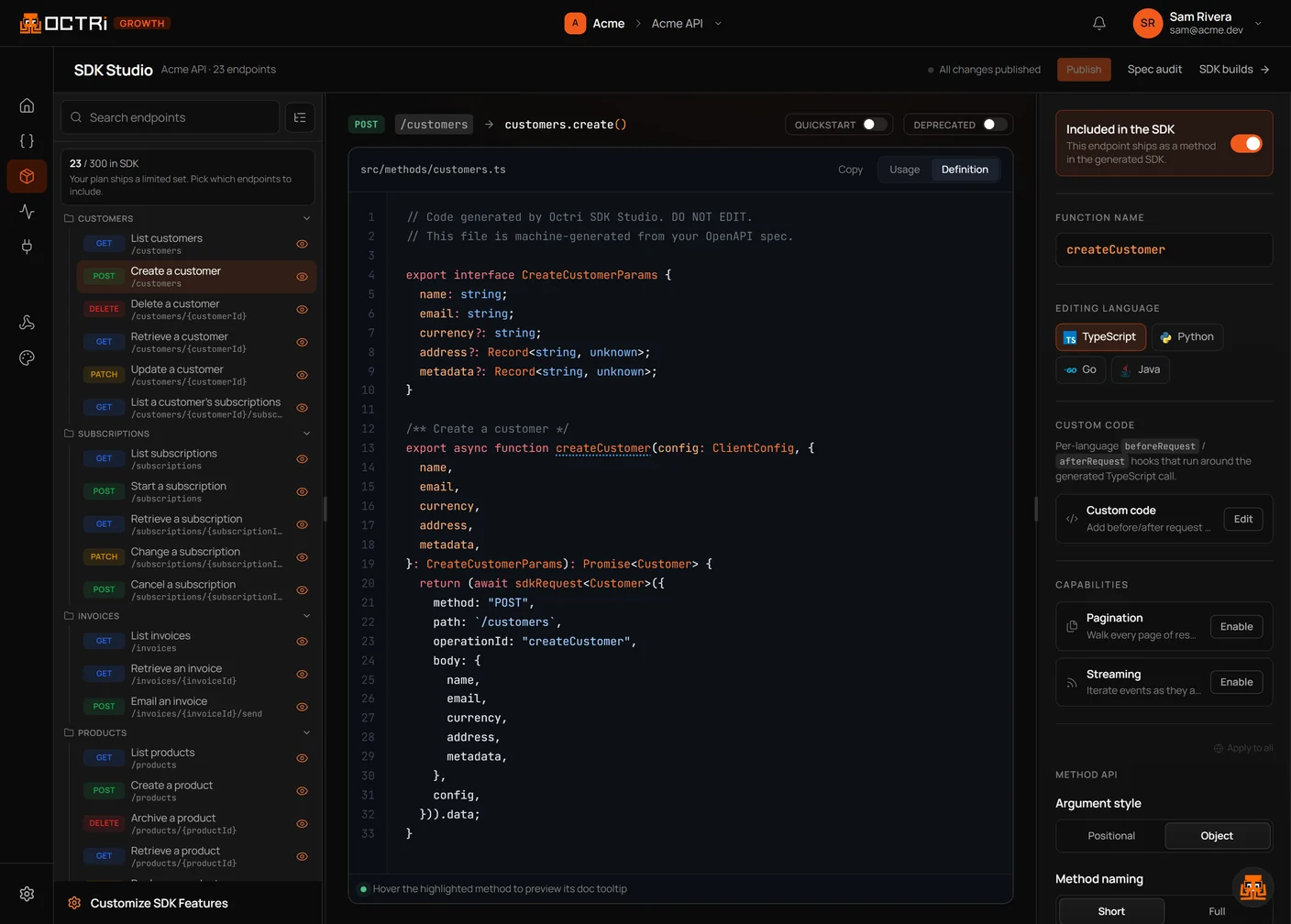
For the decisions that remain after generation, see how to customize a generated SDK.