How to Choose an OpenAPI SDK Generator: 10 Questions to Ask
Ten practical questions for evaluating generated SDKs: spec support, code quality, auth, errors, publishing, monitoring, and exit cost.
Choosing an SDK generator starts with a real API contract, not a feature grid. A small demo spec rarely contains the union types, authentication flows, pagination, and errors that make client libraries hard to maintain. Use these questions to test any generator against your own OpenAPI document before you commit to a publishing workflow.
1. Does it understand the parts of your spec that matter?
Check OpenAPI version support, references across files, oneOf and allOf schemas, nullable fields, enums, parameter serialization, request bodies, and response variants. Generate from a representative slice of your production spec. If the tool silently drops unsupported constructs, the client can compile while still describing the wrong API.
2. Is the output idiomatic in every language you plan to ship?
Language count alone is a weak measure. Compile the generated client and ask someone fluent in each target language to review naming, types, error handling, dependency choices, and public method signatures. A TypeScript client that feels natural says little about the quality of the Java, Go, or Python output.
3. Can users authenticate without writing a wrapper?
Test each authentication scheme your API uses: API keys, bearer tokens, OAuth, custom headers, and any refresh flow. Credentials should be configurable per client instance and per request where needed. Confirm that logs and thrown errors do not expose secrets.
4. What happens on non-success responses?
A useful SDK should preserve status, headers, and response body when a call fails. Check whether it gives callers a typed error, distinguishes transport failures from API errors, and lets them inspect validation details. Do not accept a client that turns every failure into an opaque exception string.
5. Are retries, timeouts, and pagination safe by default?
Try a paginated endpoint and a rate-limited one. Can callers set timeouts? Does retry logic respect Retry-After and avoid replaying non-idempotent writes unless configured? Can callers stop iteration or inspect page boundaries? These behaviors matter more in production than a polished quickstart.
6. Can you regenerate on every contract change?
Run generation twice from the same spec and compare output. Deterministic output makes code review possible. Then change one endpoint and inspect the diff. A good workflow can fail CI when generated code falls behind the committed spec, run tests on the new client, and publish a version only after those checks pass. Regeneration should be routine, not a manual rescue operation.
7. What does publishing actually produce?
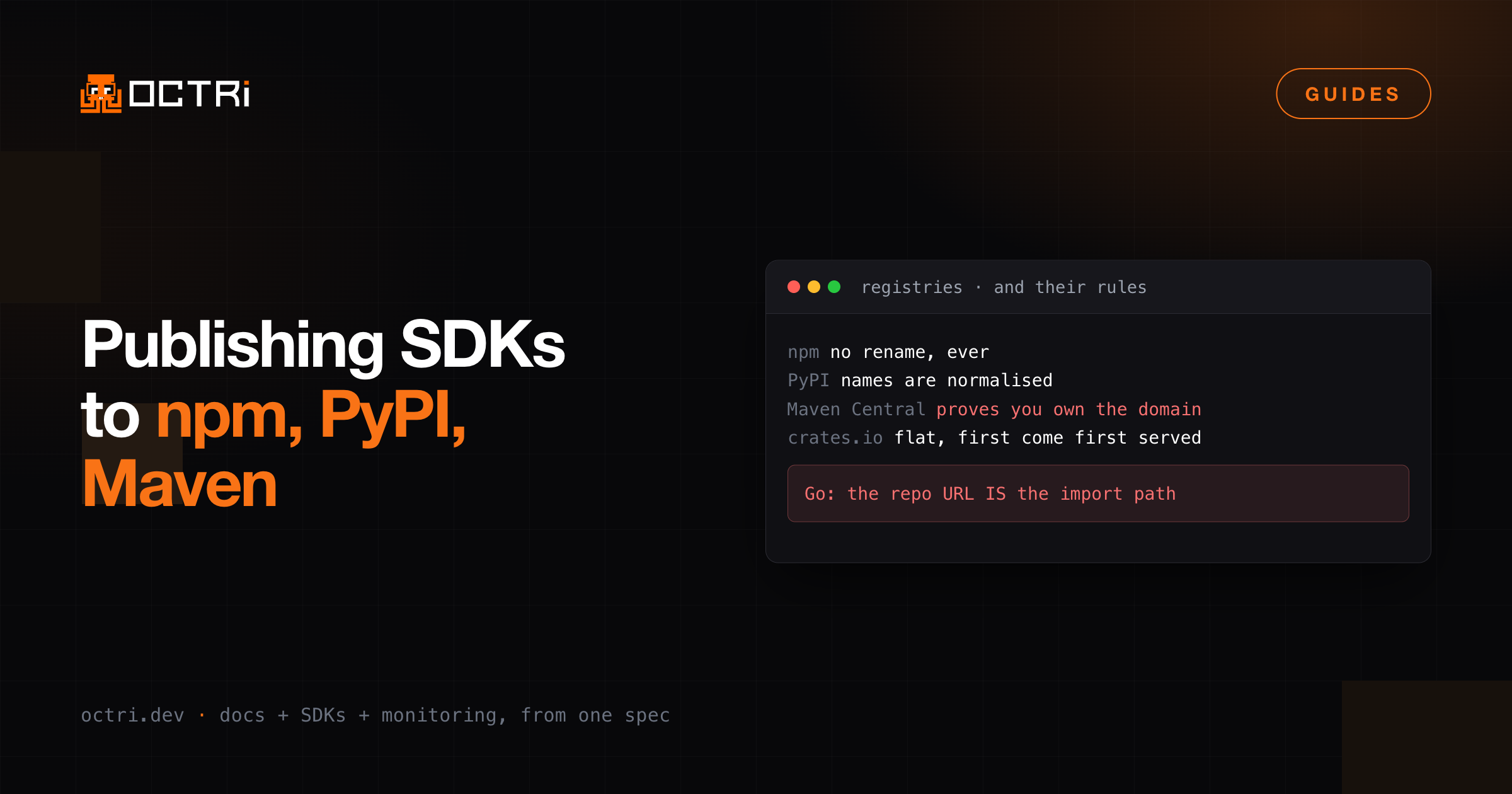
Inspect the package that users install, not only the source repository. Check registry metadata, license, README, examples, version number, dependency range, and included files. If the tool offers automated publishing, verify ownership and credentials for each registry. A successful generation step is not a successful release.
8. How much can you customize without forking generated code?
Look for supported ways to control operation names, namespaces, base URLs, user agents, transports, and hooks. Hand edits inside generated files disappear on the next run. If you must patch the output, keep that patch automated and tested, or choose a generator with the extension point you need.
9. What happens after the SDK runs in a customer's app?
Ask how users report a failure, which SDK version produced it, and how you connect that version to source. If runtime telemetry is available, verify that it is opt-in, what data it sends, and who controls it. For bundled clients, source maps and release identifiers must match the application build that shipped. Operational visibility should respect the integrator's privacy choices.
10. Can you leave later?
You should own the source, package names, registry accounts, and release history. Ask whether generated clients keep working if you stop using the service, whether you can export settings, and how much build logic depends on a hosted control plane. An exit test is simple: check out the repository in a clean environment, build the SDK, and publish a test version without vendor-specific access.
A one-hour evaluation
Pick four endpoints: one authenticated call, one paginated list, one union-heavy response, and one error case. Generate two languages your users actually use. Compile and lint both, run contract tests against staging, inspect the package contents, then change the spec and regenerate. Record failures against these ten questions. That exercise reveals more than a checklist of supported language logos.
The best generator is the one whose output your team can understand, ship, and maintain on every API change. Judge that output under the conditions your users will face, not under the tool's sample project.