Stainless Alternative: Migrate Your OpenAPI SDKs to Octri
Move a Stainless OpenAPI project to Octri: import your spec and stainless.yml, then review language, package, repository and endpoint settings.
Updated October 9, 2026.
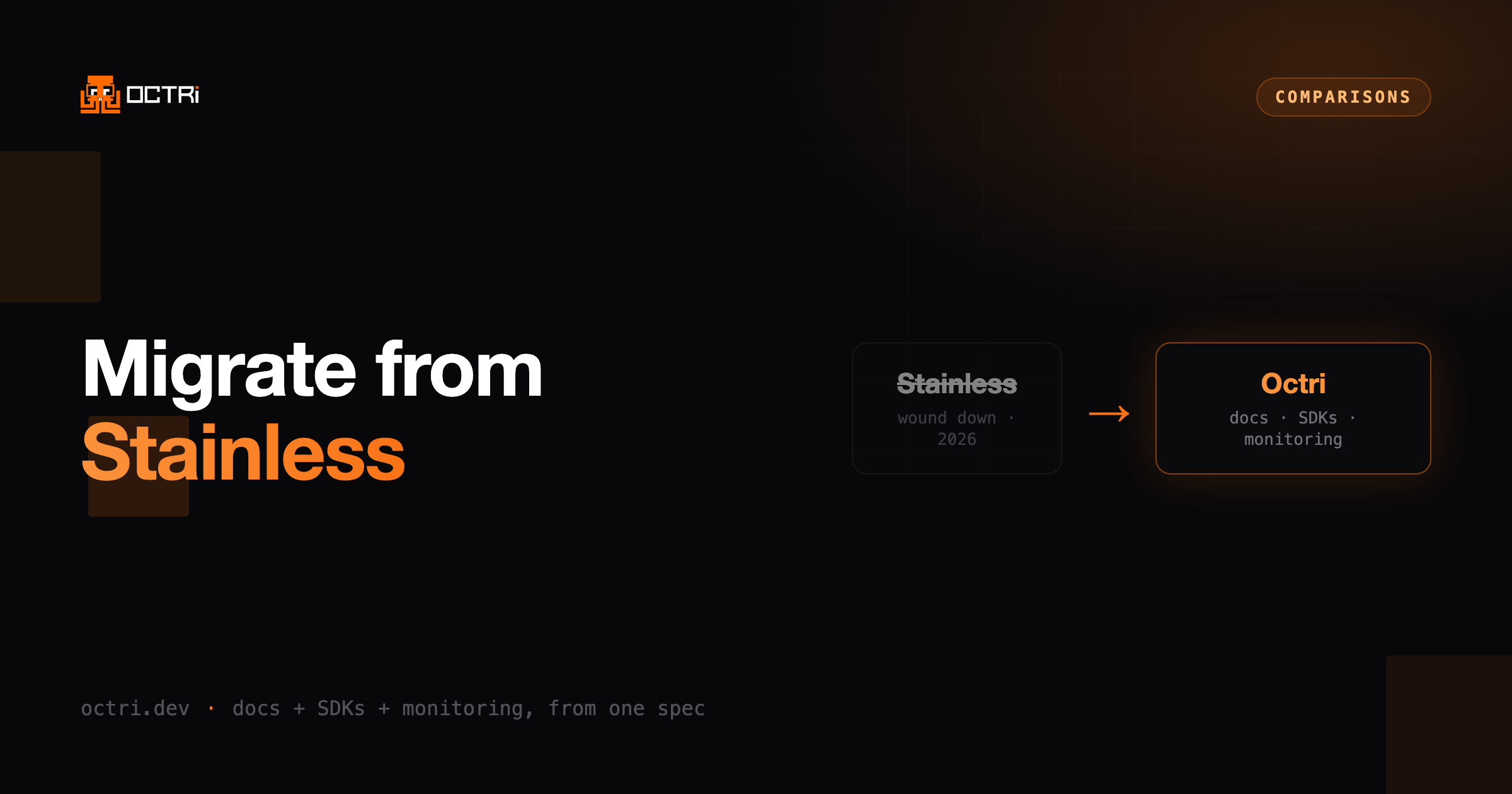
If you are moving a Stainless project, Octri imports its OpenAPI spec and reads its stainless.yml. Then you review what carried over before publishing a replacement SDK.
Migrating from Stainless? We'll move your spec over personally during the beta, at no cost. Start free or email sales@octri.dev.
Migrate in three steps
- Import your OpenAPI spec and
stainless.yml. Generating an SDK covers upload, settings and build. - Review generated settings. Confirm languages, package name, repository URL and endpoint grouping before generating an SDK. All ten languages, with install instructions and per-language options.
- Connect GitHub when ready. A connected repository rebuilds docs and SDKs when the configured spec changes. See publishing.
If you shaped SDKs with configuration, equivalents live in SDK Studio: client shape for naming and namespacing, retries and timeouts, pagination, and authentication. Inside SDK Studio is the tour.
Importing your stainless.yml
Octri's Stainless adapter reads targets and maps supported target keys to Octri SDK languages. It carries over first package_name or project_name, and first production_repo or publish_repo, converting a GitHub owner/repo value into its URL. It also imports organization.name as project name.
When resources exists, Octri uses tag-based namespacing. Resource grouping is not a one-to-one method map: method declarations within resources are not migrated from stainless.yml. Review generated method names and endpoint grouping in SDK Studio before publishing. An x-stainless-method-name extension in imported OpenAPI carries into Octri's per-endpoint method-name setting; it is separate from resources declarations.
Unsupported target keys are skipped with a preview warning. Include an OpenAPI document alongside stainless.yml; otherwise the import preview warns that it cannot find a spec.
Optional monitoring for generated SDKs
Once a generated SDK ships inside a customer's app, it can be hard to learn when it throws, on which endpoint, or for which release. Octri SDKs carry an error reporter that ships switched off. When the API owner enables it for a project, rebuilds the SDK, and its user turns reporting on, errors reach Octri tagged to the SDK release. Upload source maps from CI with the octri CLI, and the service pairs them on read so a minified production trace resolves back to source.
In practice, you see which endpoints are breaking for real integrators, ranked by how often. You fix them before the support ticket lands. Migrating off Stainless is a good moment to pick that up, not just to rebuild what you already had.
Start at monitoring setup, which covers the project switch, SDK rebuild, and each SDK user's application opt-in; then readable stack traces for the release-matching rule that makes traces resolve. Why generated SDKs break silently explains why we built it this way.
FAQ
Will my package names change? You choose your package names in Octri. If you want to keep publishing under the same names to the same registries, you can (subject to your registry ownership). See publishing for package names and registry connections, and note that Go and Swift publish by git tag rather than to a registry.
Can I keep auto-publishing on merge? Yes, if you choose that policy. GitHub spec sync defaults to a draft and diff. You can approve a release yourself or enable automatic publication on merge. Once a release builds, linked registries receive its SDKs when registry auto-publish is on; that switch can also be turned off.
Do I have to turn on monitoring?
No. SDKs work with monitoring off. To enable it, project owner turns on Monitoring and rebuilds the SDK; each developer using that SDK enables logging.enabled in their application. Setup explains both opt-ins and browser consent.
How much does it cost? Free to start (50 endpoints, 1 language, monitoring included), then $49 / $79 / $249. A fraction of enterprise SDK tooling.
Ready to migrate? Start free and import your OpenAPI spec and stainless.yml. Prefer a hand? Email sales@octri.dev.
Product names and marks belong to their respective owners. Octri is not affiliated with or endorsed by Stainless.