Why generated SDKs break silently, and how to make them observable
Generated SDKs go dark the moment they ship. Here's why they fail silently in production, and the three pieces you need to de-minify their stack traces and see the failures.
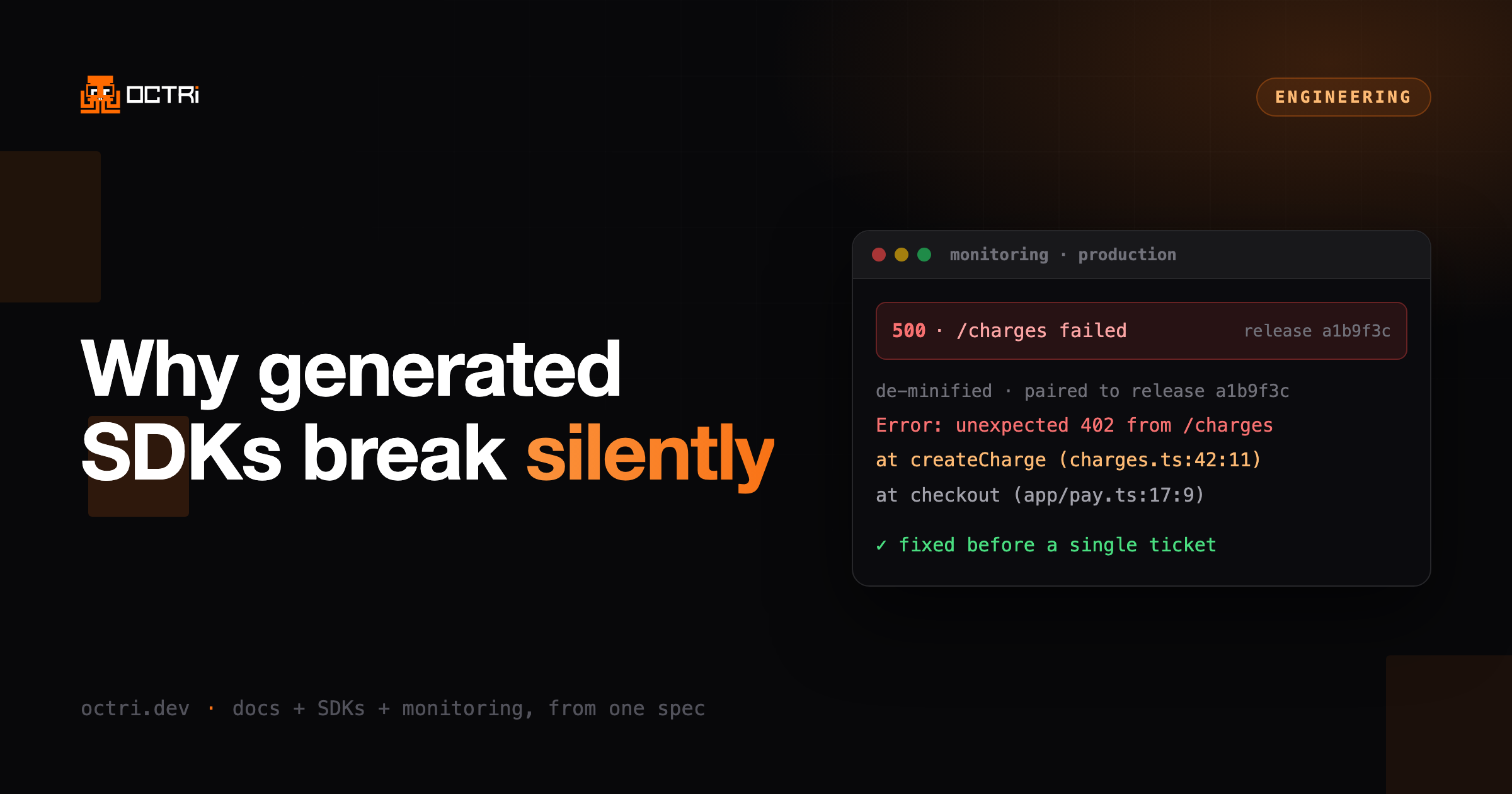
You generate an SDK from your OpenAPI spec, publish it to npm and PyPI, and integrators start building on it. Then it goes dark.
Once that client library is running inside someone else's production application, you have almost no visibility into how it behaves. An endpoint starts returning a shape the SDK doesn't expect. A serialization path throws for a subset of inputs. A retry policy turns a blip into a storm against your API. And the first you hear about any of it is a GitHub issue, a support ticket, or a customer who quietly churns without ever filing one.
We instrument our servers exhaustively. We wrap our own front-ends in Sentry. But the SDKs we ship to other developers, arguably the most important surface of an API product, are the one place we fly completely blind.
Why "just add Sentry" never happens
In principle, every integrator could wrap your SDK in their own error monitoring. In practice they don't, and even when they do it doesn't help you:
- It's their Sentry, not yours. The errors that reveal a bug in your SDK land in dozens of separate customer dashboards you'll never see.
- The stack traces are useless. They point into minified, bundled SDK code your integrator doesn't own and can't read.
- There's no shared release identity. Nothing connects the code you generated to the build the error came from.
So the signal that would tell you your SDK has a problem is scattered, minified into noise, and invisible to the one team that could fix it: you.
What "observable generated SDKs" actually requires
Three pieces have to line up. Miss any one and you're back to guessing.
1. Runtime error reporting from inside the SDK
The generated client captures failures and reports them with context: endpoint, status, SDK version, and, critically, a release tag. Only the SDK author can build this in. It has to live in the generated code itself. In Octri this is a toggle plus an SDK rebuild, since the telemetry config is compiled in at build time: see Setup.
2. Source maps, uploaded from the right build
A minified stack trace is noise until you pair it with the source map from the exact build that produced it. Here's the part that trips people up. Those maps get produced when the application bundles, in your integrator's CI, on every deploy. Not when the SDK is generated. So they have to be uploaded separately, tagged with the same release. It's the model sentry-cli sourcemaps upload already uses. Minified languages upload source maps; compiled ones like Go, Rust, and Java upload sources instead.
3. Release pairing on read
When an error arrives tagged release: abc123, the service looks up the source map tagged abc123 and de-minifies the trace against it. The match is the whole trick. Get the tags out of sync and every trace resolves to nothing.
The one rule that makes it work
The release your SDK reports at runtime must equal the release you tagged when you uploaded source maps. In practice, that's the git SHA of the same build. That one invariant is what lets an incoming production error pair with the right map and de-minify to your original source. Everything else is plumbing. This is the load-bearing constraint.
If you're implementing this on Octri rather than reading it as theory, readable stack traces is the guide for exactly this rule, including how to check the release with --dry-run before you deploy and why you should never serve those maps to users. CI setup puts the upload on every build.
What you get once it's wired up
- A production error in a customer's app arrives as a clean, de-minified stack trace that points straight at your source. Errors group into issues, so one bad deploy is one problem rather than a thousand.
- You can see which endpoints break for real integrators, ranked by frequency. It's a prioritized bug list you never had to ask anyone for.
- You fix integration bugs before they turn into tickets, bad reviews, or churn. Ship the fix and watch that build in releases, or alert on the error budget so the next one finds you first.
The takeaway
SDK generation shouldn't end at "here's your client library." Shipping the library is where its real life begins. The most interesting failures happen out there in production, in code you generated but don't run. Treat generated SDKs like any other production surface. Make them observable.
This is the bet we made with Octri. Every SDK it generates from your OpenAPI spec carries opt-in runtime reporting, plus a source-map upload command in the octri CLI and release pairing. SDK users turn reporting on. Docs and SDKs in 10 languages, monitored, from one spec. Try it free on your own spec.
Read next: the monitoring docs for how it works in the dashboard, or Inside Octri Monitoring for a tour of the views you get.