Octri vs. The Competition: Why We Win the API Toolchain (2026)
Speakeasy, Fern, and Mintlify each generate docs or SDKs and then stop. Octri is the only one we know of that keeps watching after the SDK ships, and the one we think you'd actually enjoy using. Here is the whole field, side by side.
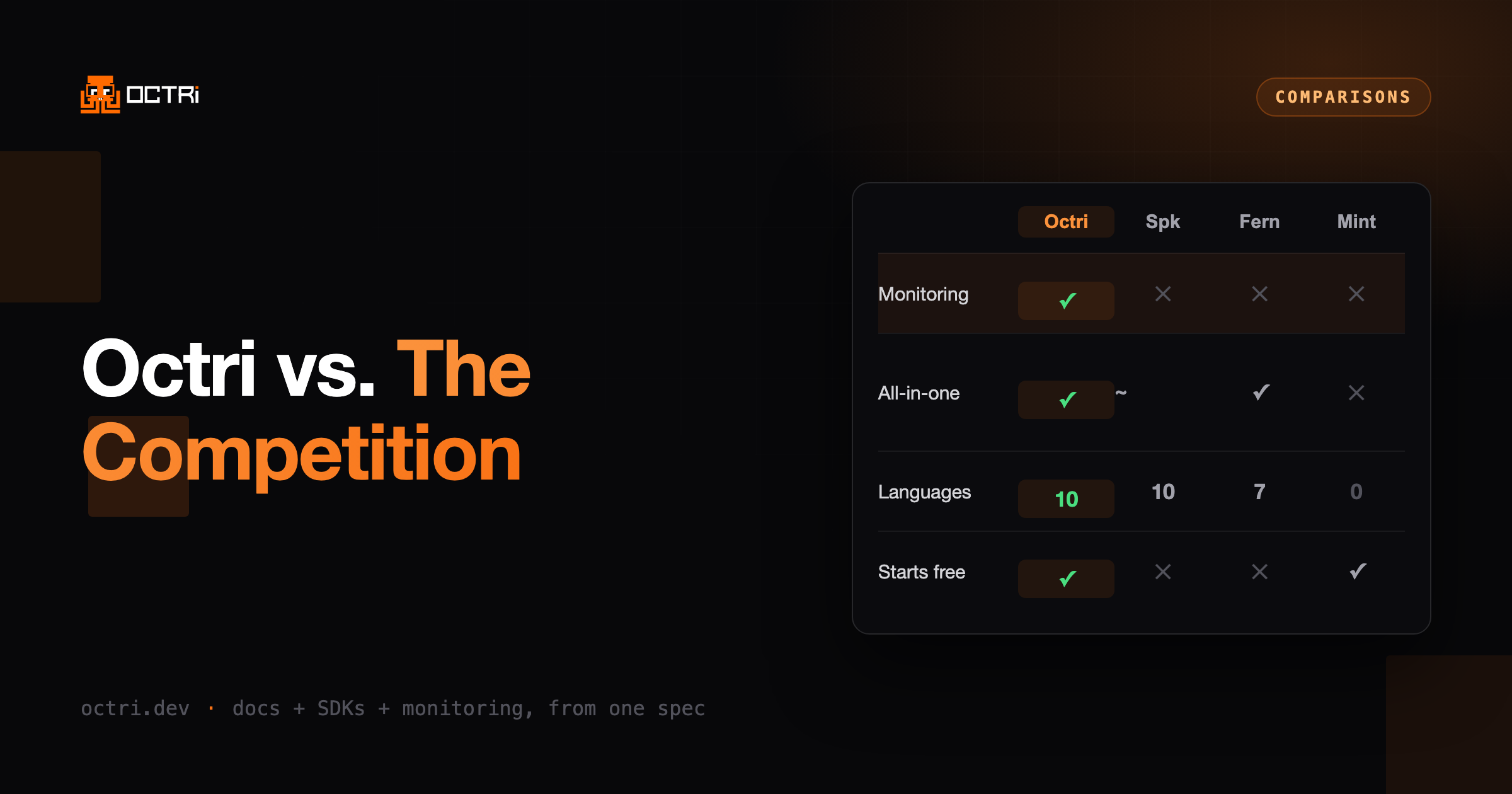
There are capable tools in this category. Speakeasy generates solid enterprise SDKs. Fern covers protocols most tools skip. Mintlify makes a clean docs site. We will say all of that plainly, because it is true.
Here is what none of them do. Each one generates something, docs or SDKs, and then walks away. The SDK ships into your customers' apps and goes dark. When it throws in production, you find out weeks later from a support ticket, not from your own tooling.
Octri is the only tool in this space we know of that keeps watching. That is the thesis, and most of this post follows from it. There is a second thing worth saying out loud, because the category avoids it: in our experience, these tools are a chore to use. Octri is built as a product you drive in a browser, not a YAML file and a build log.
The whole field, side by side
| Capability | Octri | Speakeasy | Fern | Mintlify | Stainless |
|---|---|---|---|---|---|
| Docs and SDKs in one tool | ✅ | SDK-only | ✅ | Docs-only | ✅ (wound down) |
| Production SDK monitoring | ✅ | ❌ | ❌ | ❌ | ❌ |
| Visual studio, no YAML wrangling | ✅ | ❌ | partial | ✅ (docs) | partial |
| SDK languages | 10 (incl. Rust) | 10 | 7 | 0 | 8 |
| AI-native (MCP, llms.txt, chat) | ✅ | Partial | ✅ | ✅ | Partial |
| Auto-publish on every merge | ✅ | ✅ | ✅ | N/A | ✅ (while active) |
| Starts free | ✅ | ❌ (~$250/mo) | ❌ | Docs only | n/a |
One row has a single check in it. That row is the reason Octri exists.
The one thing none of them do: watch the SDK after it ships
Generated SDKs are the least-observed code most API companies ship. You instrument your servers to the hilt. You wrap your own front end in Sentry. The client libraries you hand to other developers get nothing, and they run in code you cannot see.
Octri closes that gap because it generates the SDK and can instrument it. Every SDK reports its own runtime errors, de-minified and tagged to the exact release. You upload source maps from CI with @octri/monitoring-cli, and Octri pairs them so a minified production trace resolves back to your source. You see which endpoints break for real integrators, ranked by how often, and you fix them before the ticket lands.
As far as we have found, Speakeasy, Fern, and Mintlify have no version of this. Only the tool that generates and owns the SDK can offer it. Here is the full breakdown, and here are the docs if you would rather see the dashboard it produces: issues, traces, performance, releases, synthetics, and alerts.
The tools themselves are painful to use
This part is subjective, so try them yourself and judge. In our hands, "SDK generator" and "good UI" rarely showed up in the same sentence. Most of these products are a config file, a CLI, and a build log. You edit YAML, run a command, and read errors. Two examples we ran into:
- Fern's docs felt dated to us. The authoring and browsing experience is less polished than a purpose-built editor. Octri's API Studio is a three-pane visual workspace. You edit an endpoint, see the rendered page beside it, drag pages into groups, and publish a version. No markdown-in-a-repo ceremony to preview a change.
- Speakeasy's SDKs are customized through config. Adjustments happen in configuration files, for the options it exposes, which in our testing left less room to shape the SDK. Octri's SDK Studio turns every knob in a real UI, per endpoint, with a live preview of the generated code: package name and version, retries and backoff, timeouts, pagination strategy, streaming format, deprecations, auth, custom transforms, and which endpoints ship at all.
The pattern across the category is similar. These are tools you configure more than tools you use. Octri is the one you open on purpose.
Head to head, in one line each
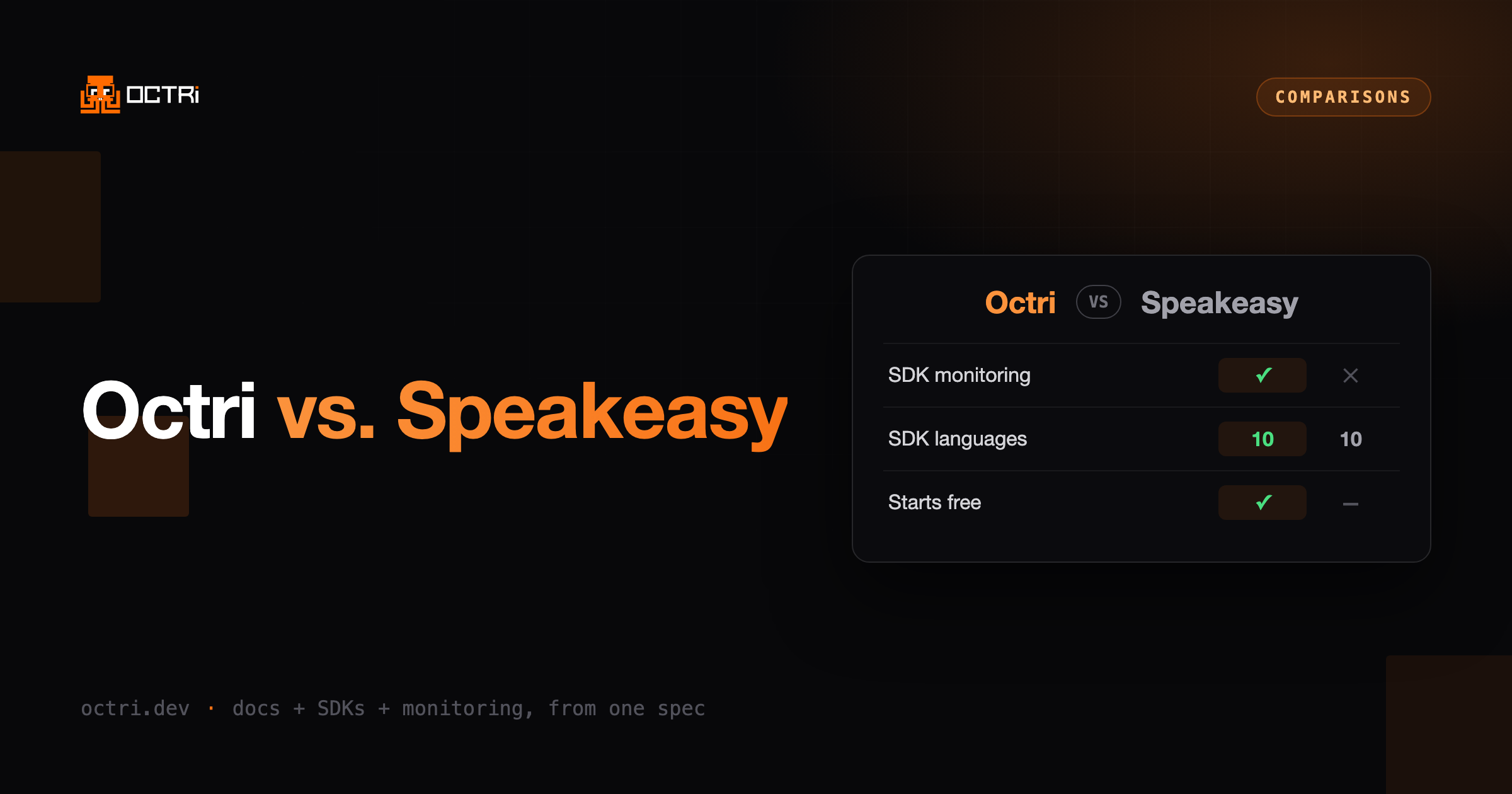
- vs. Speakeasy. An enterprise SDK generator that starts at $250/mo, with no docs and no monitoring, tuned through config rather than a UI. Octri is all-in-one, monitored, customizable in a studio, and free to start. Speakeasy's one real edge is air-gapped generation. Full comparison.
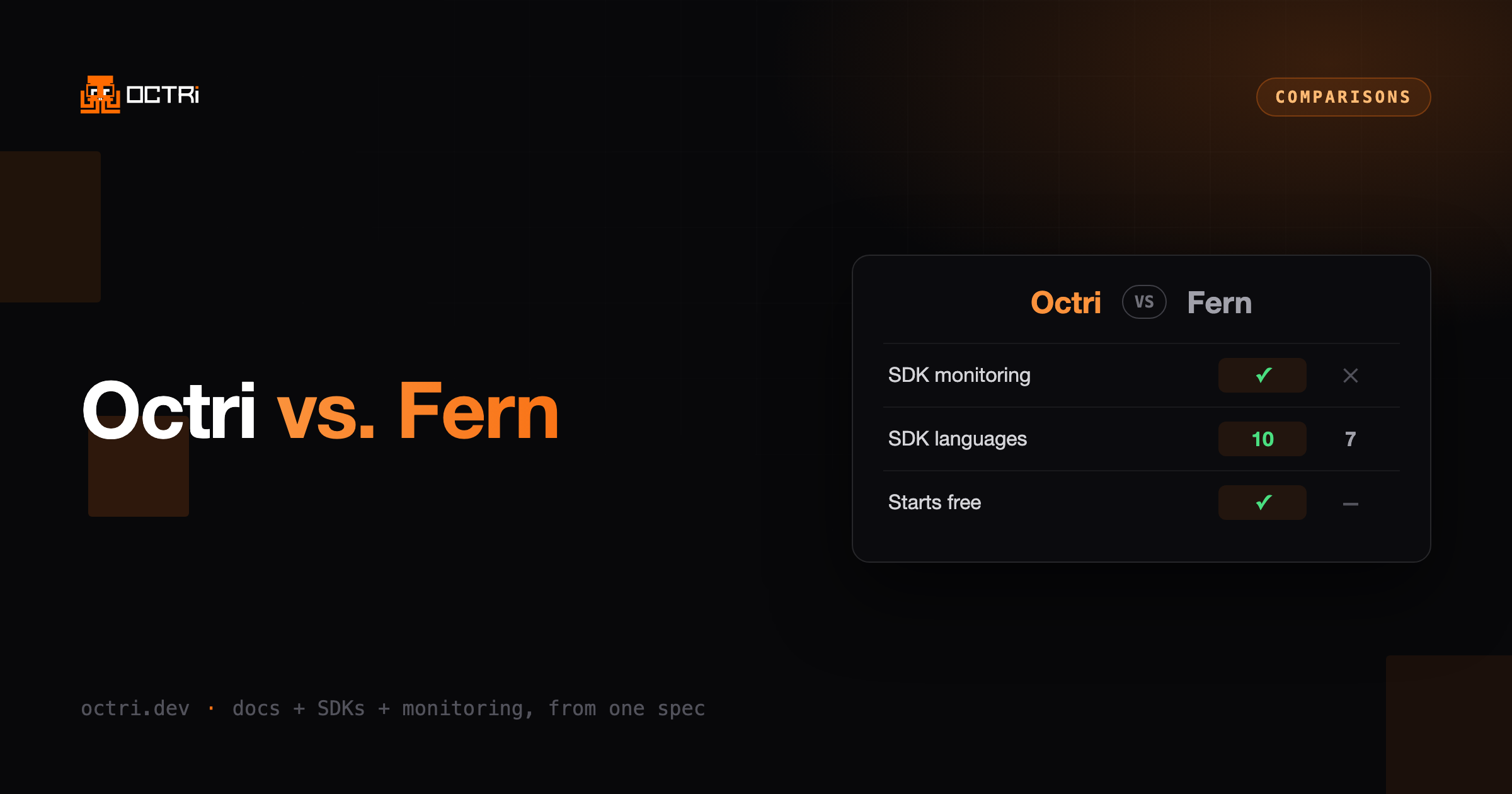
- vs. Fern. The closest match on paper: docs plus SDKs, AI-native. Octri adds monitoring Fern has no answer for, three more languages, a nicer docs editor, and a free tier. Fern's one edge is multi-protocol support. Full comparison.
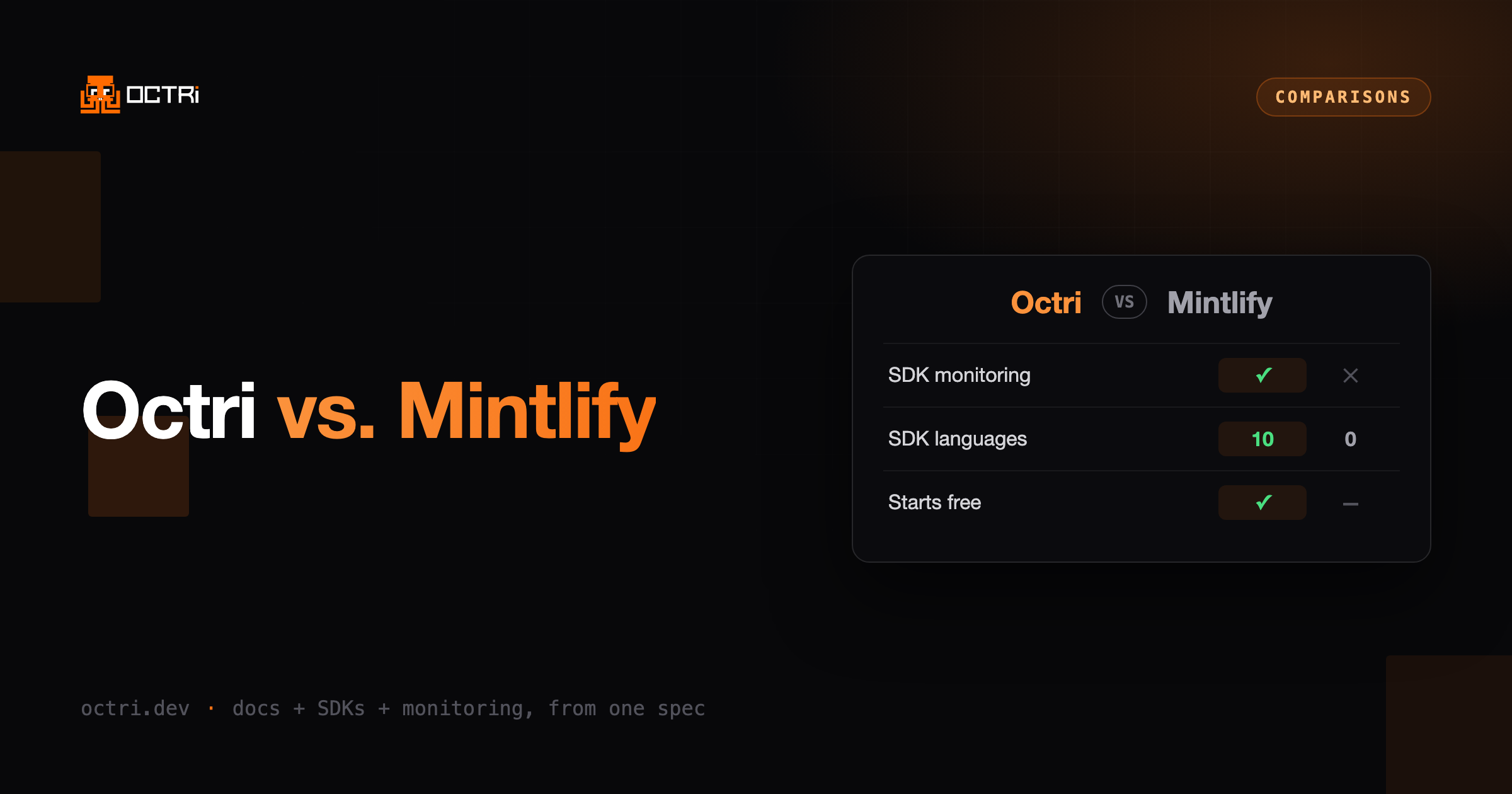
- vs. Mintlify. A docs site that cannot generate a single SDK. Octri's docs are just as polished, and they arrive with SDKs and monitoring. Full comparison.
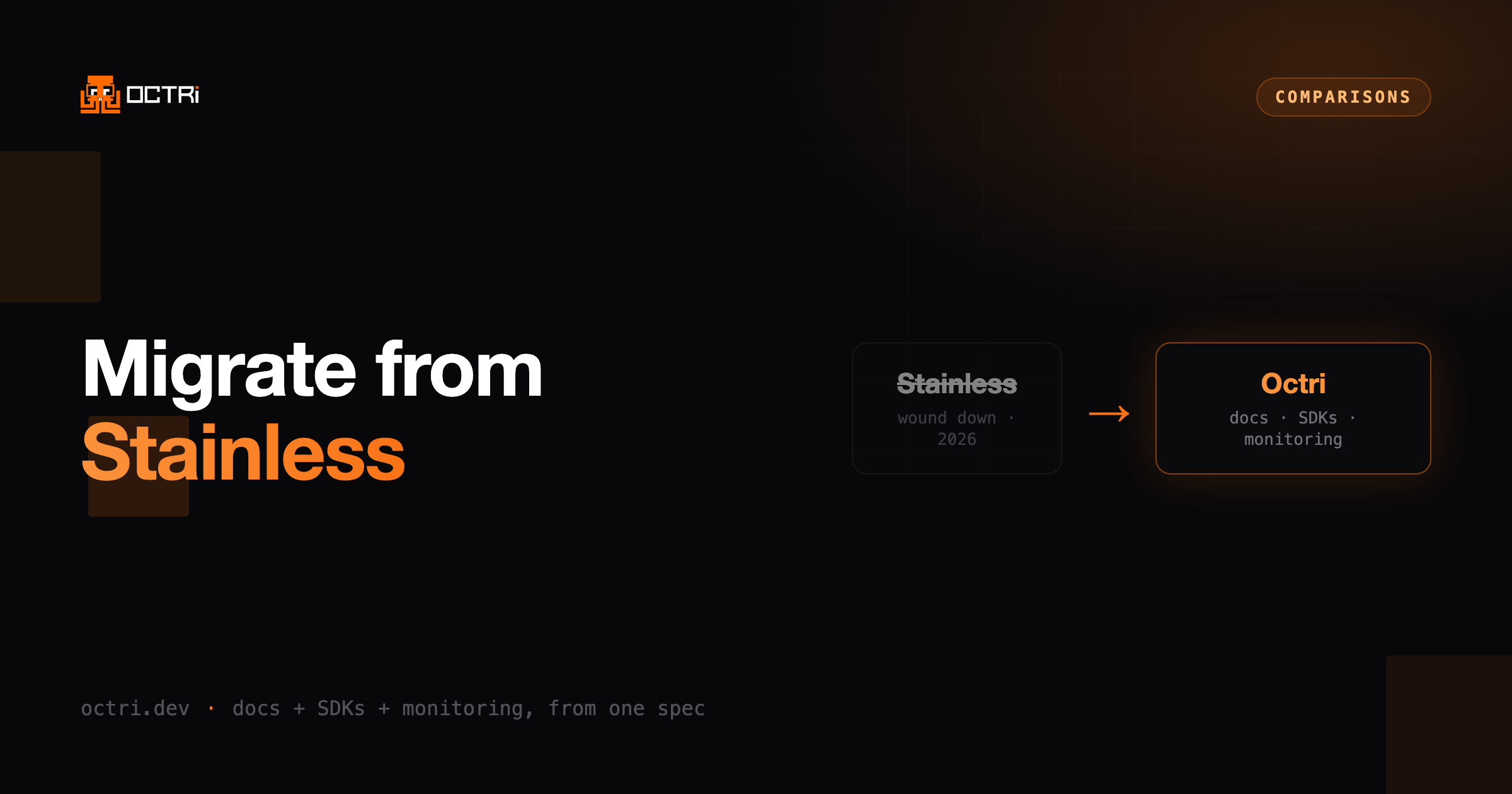
- vs. Stainless. Did all-in-one well, then wound down its hosted generator in 2026. Octri is where its users land, with monitoring Stainless never had. Migration guide.
Where the others still fit, honestly
Octri is not the answer to every requirement. Two real cases send you elsewhere. If your spec cannot touch a hosted service, Speakeasy's air-gapped binary is the move today, and our self-host is on the roadmap. If your API is event-driven on gRPC or WebSockets, Fern's protocol breadth is genuine and we are REST/OpenAPI-first. Outside those two, the comparison is not close.
Priced so you can actually start
The free tier is real: 50 endpoints, one SDK language, monitoring included. Paid runs $49 / $99 / $199, plus $50/mo per extra language, and adds endpoints, credits, custom domains, versioning, white-label, and SSO as you grow. Speakeasy starts around $250/mo. Fern is paid tiers from the top. Octri starts at zero, and zero already includes monitoring we have not found anywhere else.
The bottom line
You want docs, SDKs in 10 languages, and SDKs that tell you when they break in production, all from one spec, all edited in a studio instead of a YAML file, starting free. That is Octri. The rest of the field generates and looks away. We do not.
Rather judge the product than the pitch? The docs are open: documentation, SDKs, monitoring, and the MCP server. They are built and served by the same renderer your docs would be.
Point Octri at your spec and see it on your own API, free. Get started.
Comparisons here reflect publicly available information and our own testing as of July 2026. Products and pricing change often, so check each vendor's site for the latest. Product names and marks belong to their respective owners; Octri is not affiliated with or endorsed by them.