By the Octri team · Updated
How to keep API documentation up to date
Documentation rarely becomes wrong in a dramatic moment. A field changes meaning, a new permission is added, the API begins returning another error code, and the guide continues describing the old behavior. Weeks later, a developer copies an example that used to work and assumes the mistake is theirs.
Keeping API documentation up to date means making the reference part of the release process, and giving the written guides the same attention as the code they explain.
How do you keep API documentation up to date?
Start by identifying the source that describes the API contract. For most HTTP APIs, that is an OpenAPI file. Keep it versioned, validate it, and use it to produce the reference. Then keep the human-authored guides current too, including quickstarts, troubleshooting instructions, authentication explanations, and migration guides. Each should change whenever the workflow it describes changes.
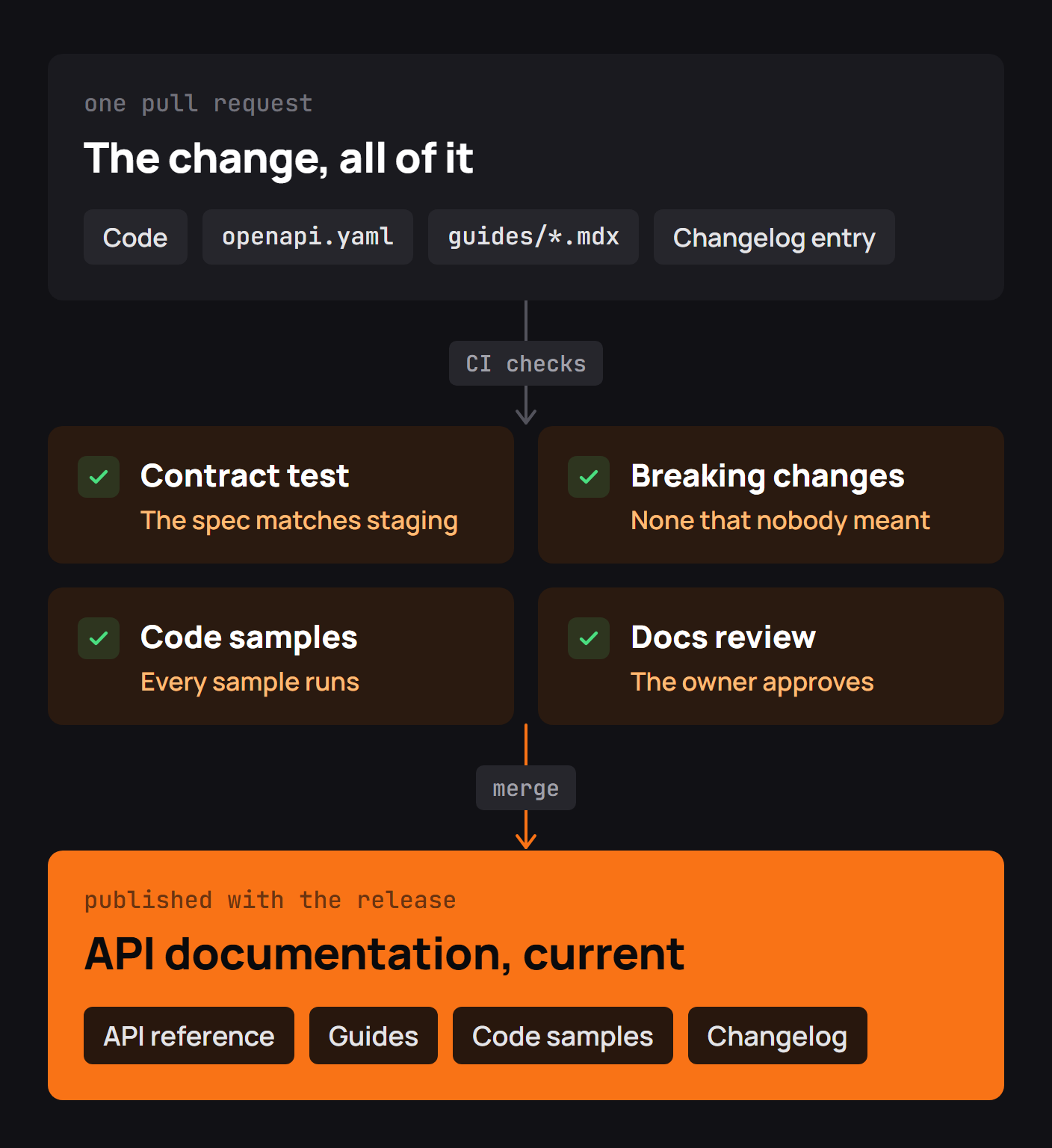
A dependable release has three parts: verify the spec against what runs, compare the new contract with the old one, and confirm the examples and guides still tell the truth. Publishing comes after those checks, not before them.
Why API documentation goes out of date
The obvious explanation is that nobody remembered to edit the docs. The more useful explanation is that the system allowed code, specification, SDKs and prose to change independently without detecting the disagreement.
Stripe's engineering team described the difficulty in a detailed account published in June 2026. In How API changes flow into Stripe's developer products, engineer Mikael Mello and technical writer Anna Mason explain how different internal representations of Stripe's v1 and v2 APIs left developer tools consuming different descriptions. SDK and reference generators needed separate implementations, and some tooling could not support the new APIs at all. The team moved toward OpenAPI as a common representation so a single API change could flow into multiple developer-facing products.
Stripe is operating at a scale most teams never will. But the underlying problem is familiar: when each publishing surface has its own source, somebody has to reconcile them by hand. The fewer independent versions of the contract you maintain, the fewer opportunities there are to contradict yourself.
Make the OpenAPI spec the source of truth
There are two reasonable starting points. In a design-first workflow, the spec is reviewed before an endpoint is implemented. In a code-first workflow, framework annotations or route definitions generate it. Either can work if the relationship is enforced and the output is checked.
For example, a service can generate openapi.json during its build and compare it with the committed file. If they differ, CI asks whether the code changed without a corresponding contract update. This does not prove every response is correct, but it catches one common form of drift before a release.
Do not forget the descriptions. Generating schemas from code gets you types and routes. It does not automatically explain whether an optional field means “use the default,” “clear the value,” or “leave it unchanged.” Those distinctions need deliberate writing in the source your reference generator reads.
Regenerate the reference on every release
Once the spec is reliable, treat the API reference like a generated build artifact. Parameter tables, required markers and response schemas should come from the same contract you test and publish, not from someone retyping them into a web editor.
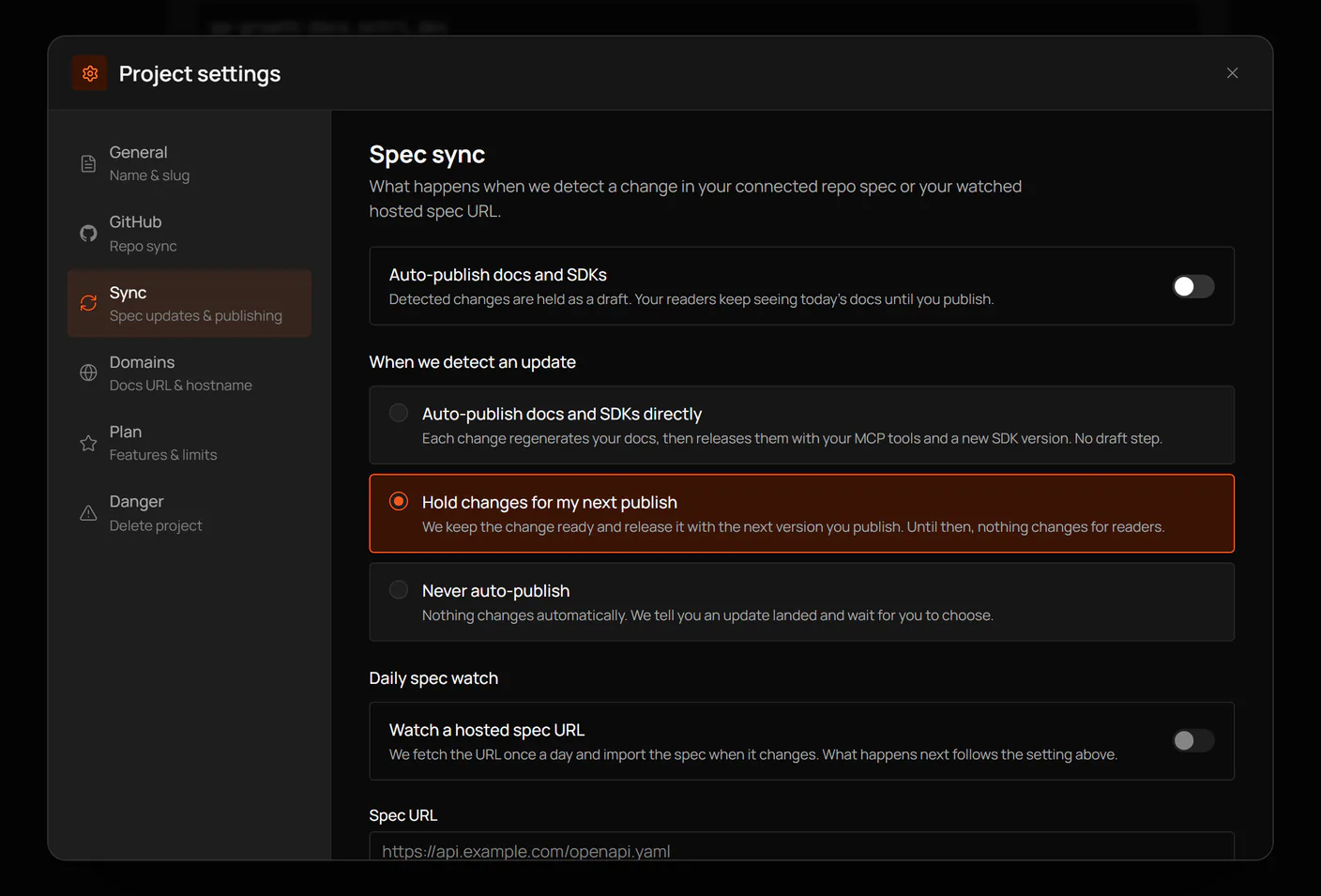
Decide how visible changes become. Some public APIs need a review or scheduled publication step; internal services may publish immediately when the corresponding code deploys. What matters is that the reference never silently jumps ahead of the running API or remains behind it for weeks.
Check the spec against the API
A generated reference is only as reliable as its input. Contract tests close the gap between the OpenAPI description and the actual HTTP behavior.
Tools such as Schemathesis can derive requests from a spec and check responses against the declared schemas. Run them against a test deployment with safe credentials and data. A documented 200 response that suddenly lacks a required field should fail before that release reaches customers.
That does not replace task-level testing. A response can match its schema and still be useless to a developer following a guide. Keep a small set of smoke tests for the workflows your documentation promises: obtain a key, create a resource, fetch it again, handle a representative error.
Catch breaking changes before they ship
Schema comparisons help distinguish routine additions from changes that may break existing clients. Removing a response field, making a request field required, or narrowing an accepted value set deserves special attention. A tool such as oasdiff can compare two specs and report compatibility issues.
The result is a review signal, not an automatic verdict. Your team still has to decide whether the change is intentional, which versions it affects, and what migration support customers need. Document that decision in the pull request while everyone still remembers why it was made.
Update the guides in the same pull request
A reference can be generated from the spec. A guide explains an outcome, which may require several calls and several bits of context. It needs human review.
When an API change alters a workflow, include the guide update with the implementation or make it an explicit release blocker. If an endpoint now requires a new scope, the authentication guide and the task guide should agree with its reference. If pagination changes, update the loop in the sample SDK code, not just the endpoint's query parameters.
A short pull-request template helps:
- [ ] Contract and implementation agree
- [ ] Affected guides and examples are updated
- [ ] Breaking changes have migration guidance
- [ ] The changelog explains the reader impact
These boxes are useful only when reviewers know they are allowed to ask for evidence.
Run every code sample in CI
Examples are executable promises. Treat the important ones like tests. A short Python sample should import the published SDK, initialize it the way the current release expects, make a safe request and check a meaningful result. A cURL example can be exercised against a test environment.
Not every sample belongs in CI. A tutorial that provisions expensive resources or calls external payment systems may need a mock or a separate integration environment. The important distinction is between examples that are verified and examples that nobody has attempted to run since they were written.
Deprecate before you remove
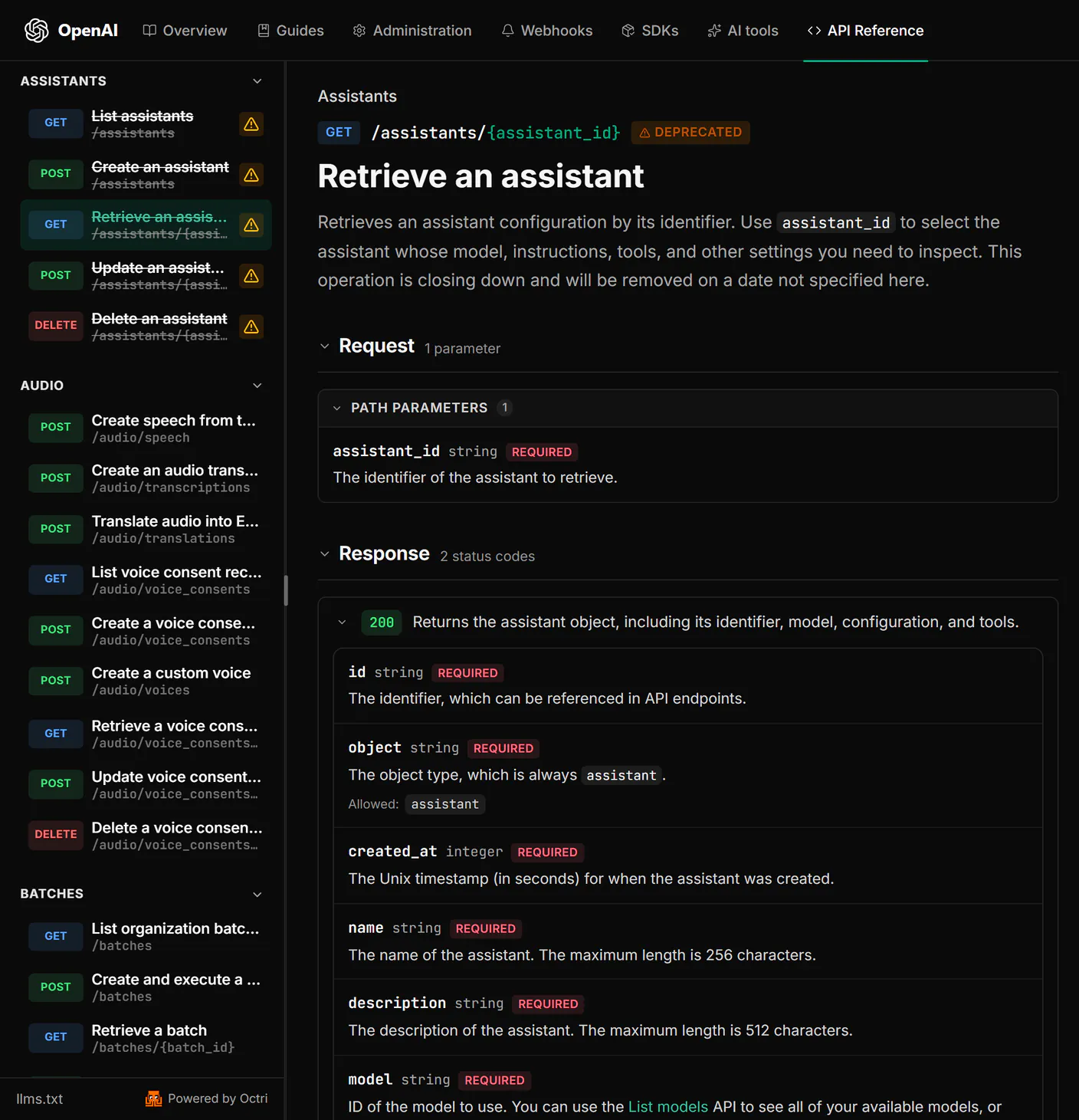
A deprecation notice should tell a developer three things: what is retiring, what replaces it, and when the old behavior ends. Those facts belong in the reference and in the migration guide, not only in a release note buried in a feed.
The standard Deprecation header can signal when a resource became deprecated; the Sunset header announces a planned end of availability. When your API uses them, document the meaning and dates, and provide links to migration instructions.
Write the changelog as you go
A useful changelog describes how an integration is affected. “Updated customer API” is not enough. Name the endpoint, explain the new behavior, mark breaking changes and link the migration path. For example, explain whether a new field is optional, whether an error response changed, or whether an SDK method needs a new argument.
Write the entry in the same review that approves the behavior. The context will be harder to reconstruct after the release, especially when one change spans the spec, several SDKs and the documentation site.
Maintain API documentation as a team
Automation checks structure; people maintain meaning. Give each major guide an owner. Track searches that return nothing, pages that readers mark unhelpful and support questions that repeat. When a user reports a documentation problem, reproduce the task before rewriting the sentence.
Stripe's account is a reminder that “keep docs in sync” is ultimately an architecture problem as well as an editorial one. Its engineers needed a common representation across products. Smaller teams need a simpler version of the same discipline: one contract, checks around it and a named owner for the parts a schema cannot describe.
API documentation maintenance checklist
- The OpenAPI description is generated or reviewed as part of implementation.
- Contract tests verify it against a running environment.
- Breaking-change checks compare it with the last published version.
- The reference is rebuilt from the correct spec for each release.
- Guides and SDK examples are reviewed whenever the workflow changes.
- Important examples run against tests or staging.
- Deprecation notices say what changes and when.
- Changelog entries explain user-visible consequences.
- Someone owns the final review of the published site.
Keep API documentation up to date with Octri
Octri API Studio can generate reference pages and request examples from OpenAPI, and synchronize changes from a repository or hosted specification. Teams can choose whether to publish detected changes immediately or review them first; version and changelog features help communicate changes to readers.
The strongest setup pairs those publishing tools with contract checks in your own CI and an editorial review of affected guides. A spec that updates itself is valuable, but the promise to your readers is larger: the next request they copy should still work, and they should understand why when it doesn't.