By the Octri team · Updated
Why build an SDK for your API? Benefits and costs
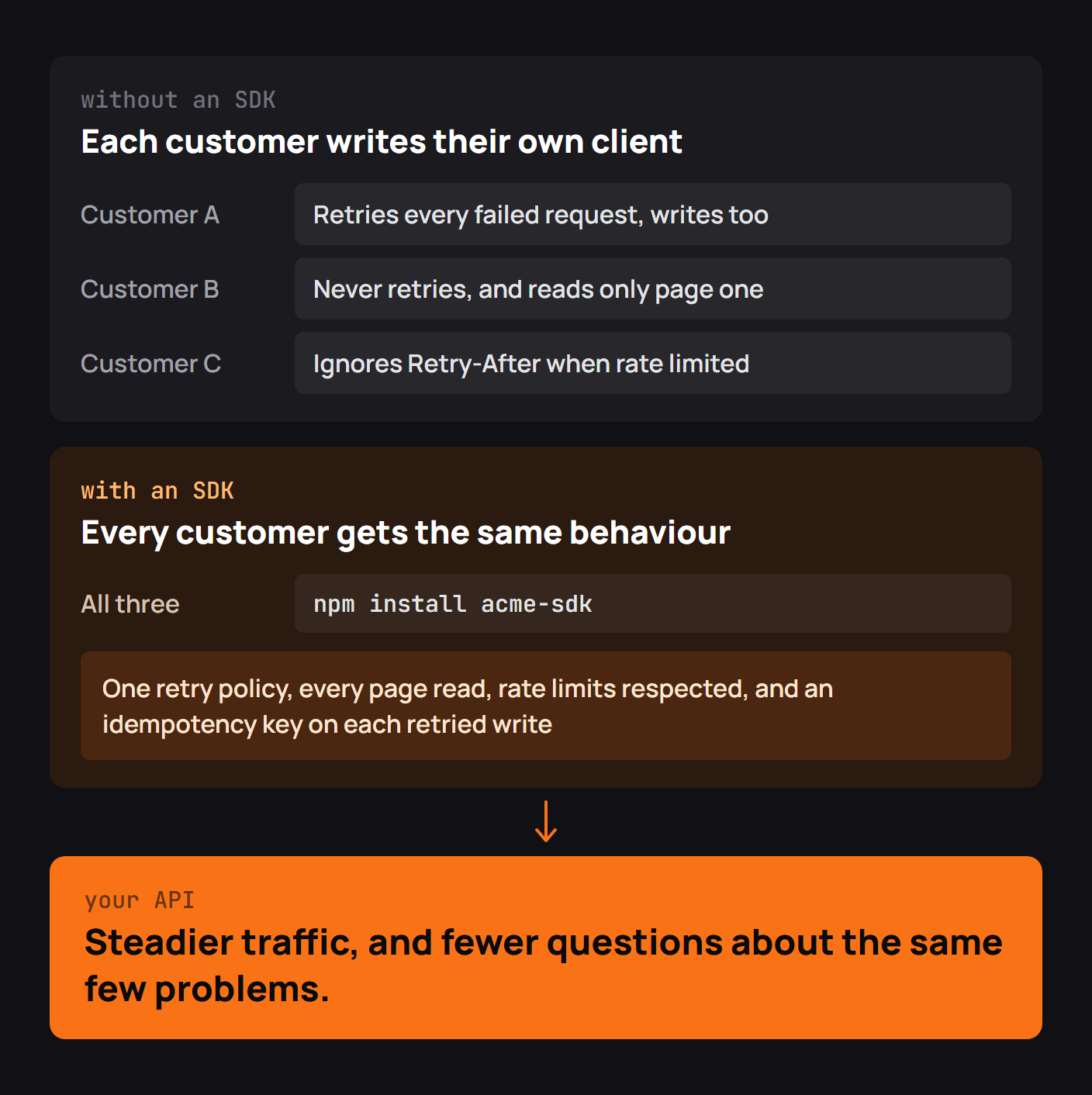
The first successful API request is only the beginning of an integration. The harder part is what every customer writes next: a loop around pagination, an authentication helper, a retry policy, a mapper from error codes to exceptions. An SDK is worth considering when those pieces are being rewritten across customer codebases, sometimes with subtly different behavior.
Why build an SDK for your API?
An official SDK turns recurring integration decisions into one maintained implementation. Developers get a familiar interface, autocompletion and a smaller amount of code to own. The API provider gets a place to enforce consistent handling of timeouts, retries, pagination and errors, and a predictable way to announce changes through a package release.
Those benefits aren't automatic. A poor SDK can introduce its own bugs and hold users back from newly released endpoints. The decision should be based on the complexity it removes and the commitment your team can sustain.
What happens without an SDK
There is a revealing firsthand account on SDKs.io about community-maintained libraries at Xero. The author describes a period when the company relied on independent maintainers instead of resourcing its own SDK program. Some community projects became popular enough to appear in its developer portal. Later, one maintainer was overwhelmed and asked for a dedicated engineer; the team could not provide one. When Xero needed clients to support a TLS upgrade, maintainers were asked to do more unpaid work, and the relationship became strained.
The incident exposes a cost that doesn't appear in the initial project estimate. Someone will maintain the interface developers depend on. If the provider calls it official without making ownership real, users and volunteers both inherit a fragile promise. Building your own SDK is one answer; genuinely supporting community maintainers is another.
Who ships SDKs
Stripe provides server-side libraries in several languages, Twilio publishes helper libraries and GitHub maintains Octokit clients. These are useful examples because their packages have grown around real integration needs rather than a desire to fill a language matrix. Look at their README files as closely as their method counts: installation, authentication, pagination and errors are where the experience becomes concrete.
A provider can also offer a command-line tool, a Postman collection or direct examples for smaller audiences. An SDK should complement the API itself, not become the only way its endpoints can be used.
What an SDK costs your team
Each release requires keeping methods in sync with the API, testing its request shapes, supporting current language runtimes, producing package artifacts and explaining changes. The visible code is only part of that workload. Owners will triage issues from old versions, respond to dependency vulnerabilities and maintain migration guides.
Generation can take much of the repetitive work away, but it does not decide whether a Ruby method feels idiomatic or whether a Go retry should honor cancellation. Those decisions still need engineers who understand the ecosystem.
When your API can do without an SDK
For an internal service with one known caller, a few endpoints and an established shared HTTP client, a dedicated package may add more ceremony than value. The same can be true for APIs mostly consumed through no-code platforms or managed integrations. Publish an accurate reference and runnable examples first, and watch where developers get stuck.
If support keeps helping customers implement the same cursor loop or request-signing algorithm, the threshold has probably changed. That repeated cost is a better signal than an arbitrary endpoint count.
Which languages to start with
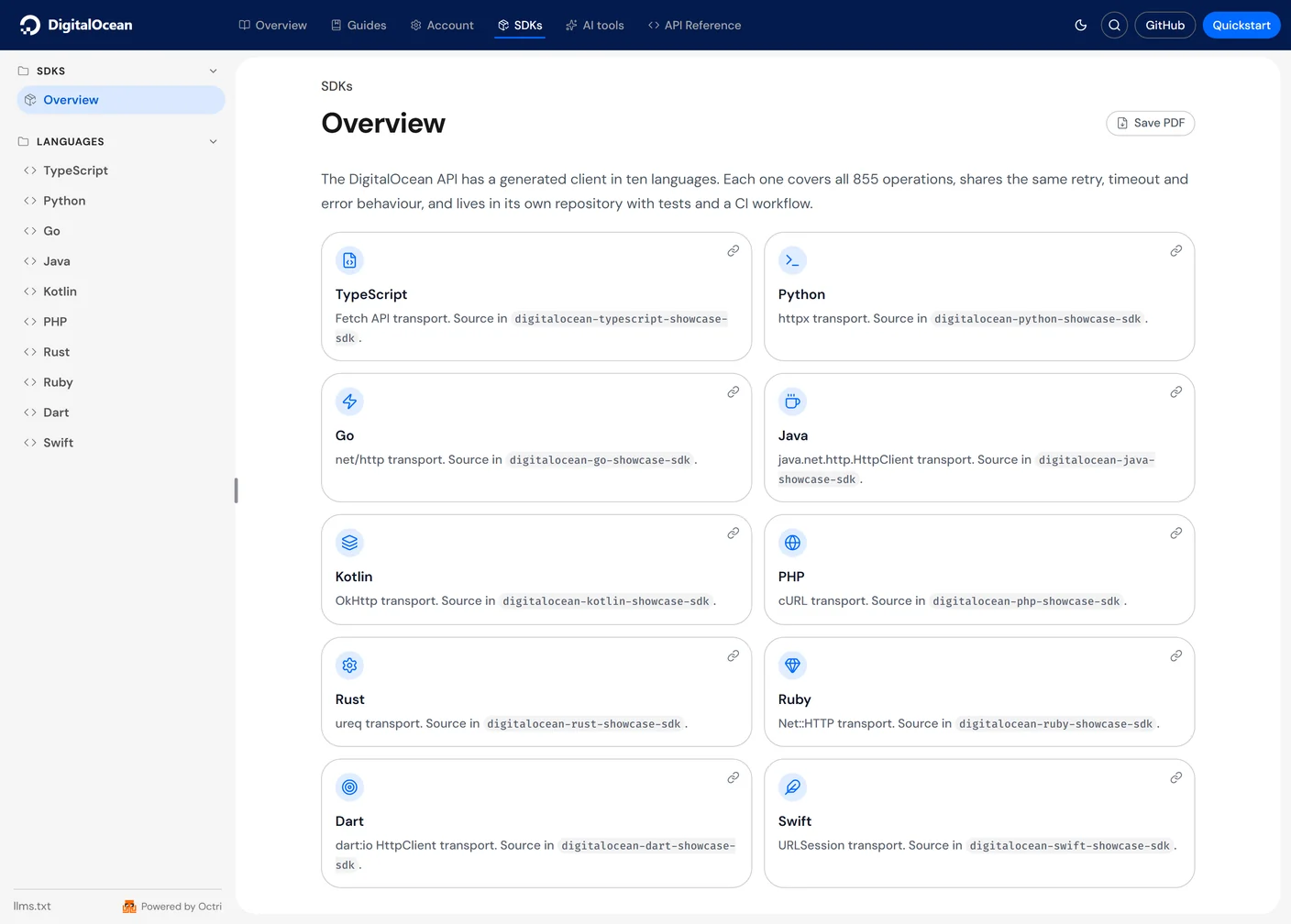
Use actual usage and audience data. TypeScript and Python cover a broad set of web and automation workflows; Java, C#, Go, PHP, Ruby, Swift or Kotlin may be more important for your market. Plan for one team to maintain the languages you promise, not merely to run a generator once. Which languages should your SDK support? develops a practical selection method.
How to tell whether your SDK is working
Measure install-to-first-success time with a clean project and a new developer. Watch the share of traffic coming through official clients, the versions still in use, the frequency of pagination and authentication support tickets, and how quickly an API change reaches all packages.
One useful test is to ask someone unfamiliar with your API to complete a realistic integration without assistance. Count the questions they have to resolve in source code or support tickets. A rising download count is encouraging; a shrinking amount of integration friction is better evidence.
Checklist: deciding on an SDK
Write down the repeated integration problems, the languages with proven demand, the minimum runtime and transport policy, a release owner, and the tests required to publish. Decide how long older majors will receive fixes. If no one owns the package after the first release, postpone the launch until the maintenance path is credible.
SDKs for your API with Octri
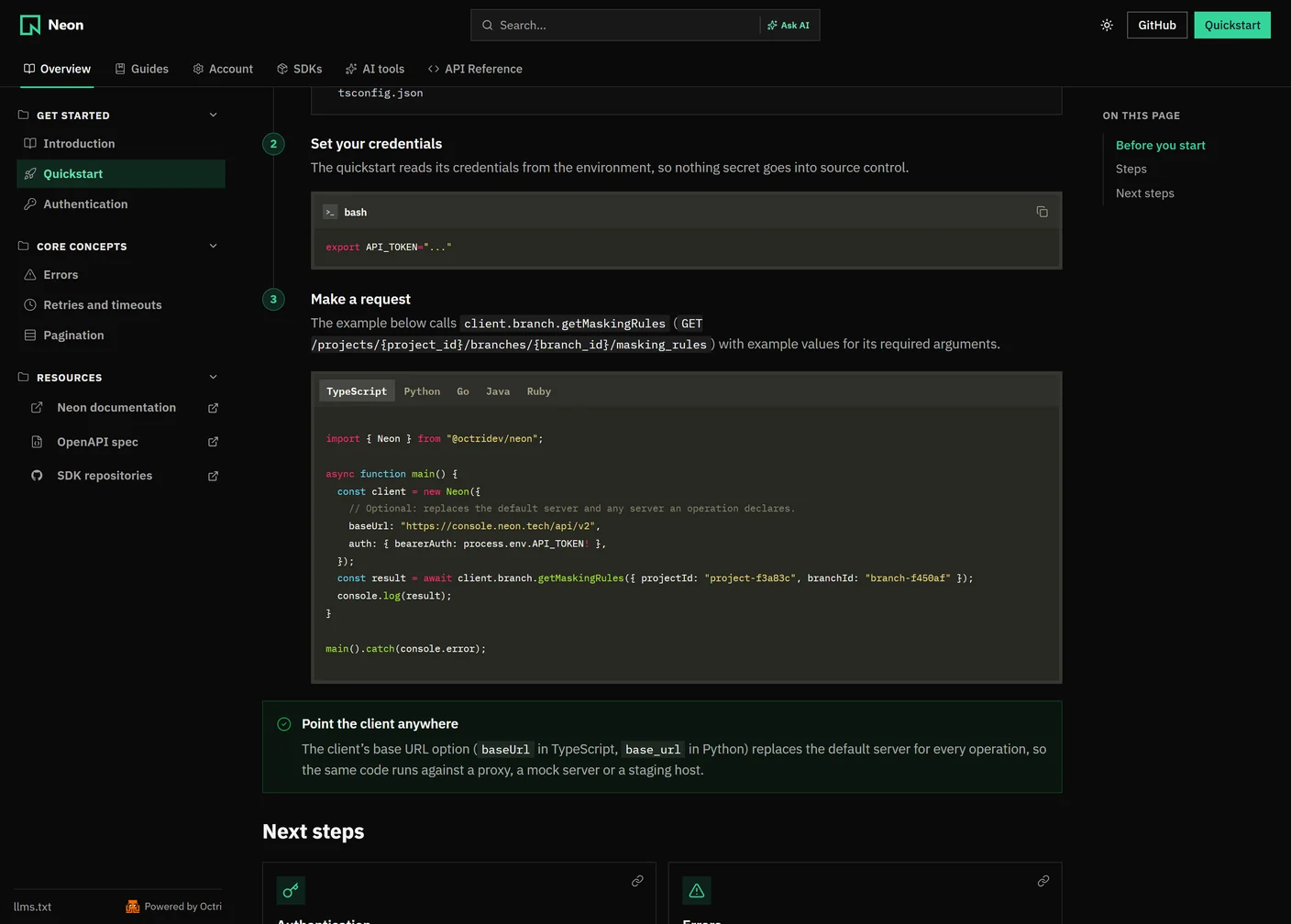
Octri takes an API description and produces SDKs whose methods and behavior can be customized across languages. Generated documentation and previews help you inspect whether the interface makes sense before distribution. That can reduce the mechanical cost, leaving more time for the language-specific decisions developers will notice.
For a deeper comparison of maintenance approaches, read generated vs handwritten SDKs.