Octri
API StudioSDK StudioMonitoringMCP ServerFeatures
ComparePricingBlogDocs
Log inStart for free
Octri
API StudioSDK StudioMonitoringMCP ServerFeatures
ComparePricingBlogDocs
Log inStart for free
Blog/Guides
Guides·July 1, 2026·1 min read

How Octri Keeps Static Pages Fresh with ISR

A look at how incremental static regeneration and on-demand revalidation give you static-fast pages that update the moment your content changes.
#nextjs#isr#performance

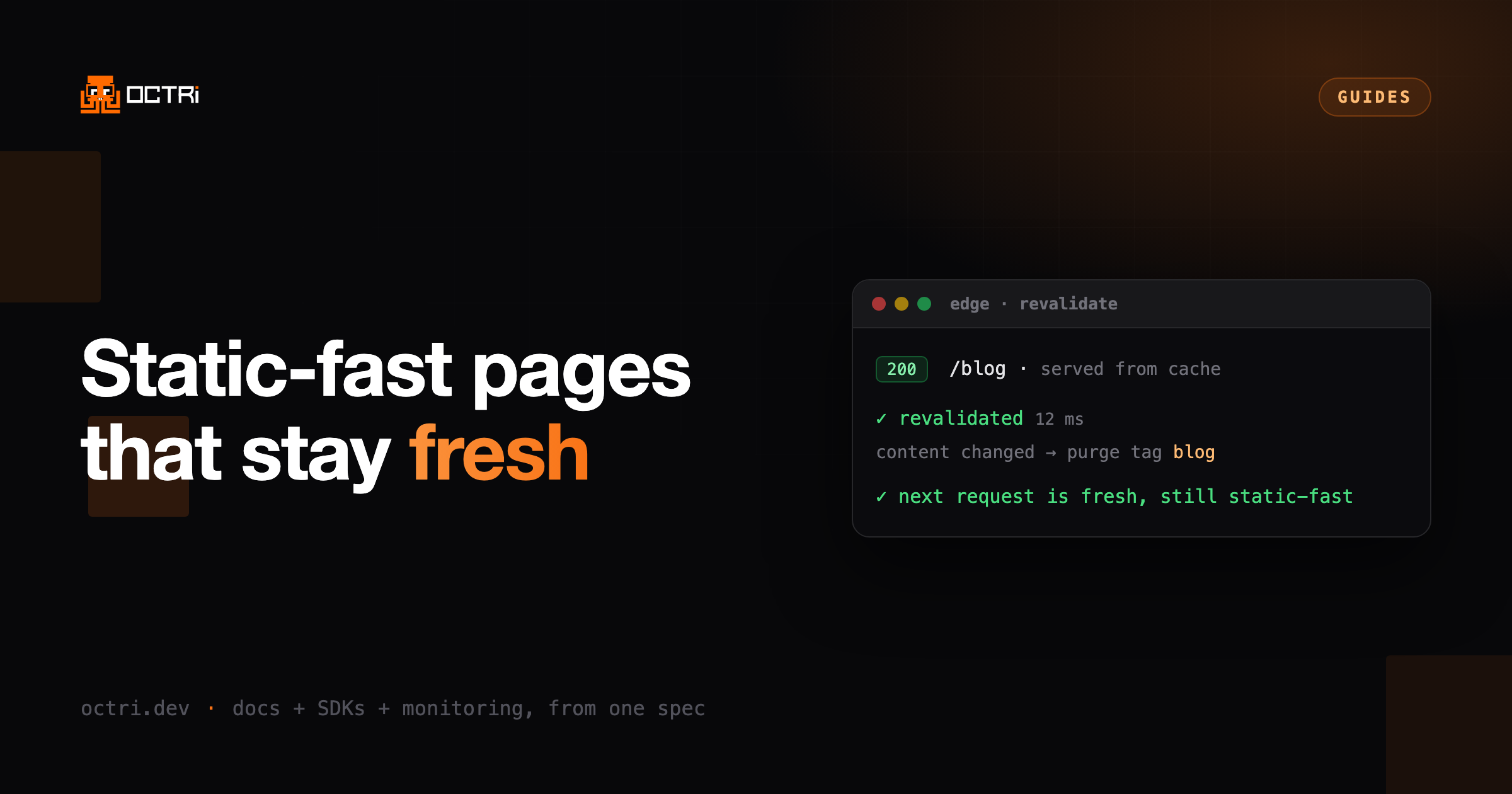
Static pages are fast because there is nothing to compute at request time. The classic trade-off is staleness — but incremental static regeneration (ISR) plus on-demand revalidation removes it.

The two halves

  1. ISR serves a cached, statically-rendered page and rebuilds it in the background on a time interval.
  2. On-demand revalidation lets a content change push an update immediately, instead of waiting for the interval.

Together you get pages that are static-fast and never meaningfully stale.

How the blog uses it

When you run the sync script, it tells the API which articles changed. The API purges its own cache and forwards the changed slugs to the frontend, which revalidates only those pages:

typescript
123
// Only the pages that actually changed are purged.
revalidateTag("blog");
for (const slug of slugs) revalidateTag(`blog:${slug}`);

The result: publish a post, run one command, and the new article is live in seconds — with every other page still served from cache.

When to reach for it

  • Content-heavy pages that change occasionally (docs, blogs, marketing)
  • Anything where SEO and time-to-first-byte matter
  • Workflows where a script or CMS webhook can signal "this changed"

If your content changes on every request, ISR is the wrong tool — reach for dynamic rendering instead.

← PreviousTen Habits for Writing Great OpenAPI Specs
Next →How to Generate API Documentation from an OpenAPI Spec (2026 Guide)

Related articles

Guides·6 min read

How to Generate API Documentation from an OpenAPI Spec (2026 Guide)

A practical, step-by-step guide to generating accurate, always-up-to-date API documentation from an OpenAPI specification — and how to keep it in sync automatically so it never drifts from your code.

July 2, 2026
Comparisons·6 min read

Octri vs. The Competition: Why We Win the API Toolchain (2026)

Speakeasy, Fern, and Mintlify each generate docs or SDKs and then stop. Octri is the only one we know of that keeps watching after the SDK ships, and the one we think you'd actually enjoy using. Here is the whole field, side by side.

July 7, 2026
Product·3 min read

Inside Octri API Studio: Docs You Edit Like an App, Not a Repo

API Studio is a three-pane visual workspace for your docs. Edit an endpoint, watch the page render beside it, drag pages into groups, tune the playground and SEO, and publish a version. No markdown-in-a-repo ceremony.

July 6, 2026
Product·3 min read

Inside Octri Monitoring: Observability for the SDKs You Ship

The SDKs you hand to other developers are the least-observed code you ship. Octri Monitoring watches them: de-minified stack traces tagged to a release, grouped issues, traces, performance, alerts, and a live tail. Included on every plan.

July 6, 2026

Ship notes, straight to your inbox

New SDK languages, changelog highlights, and the occasional deep-dive on docs that don't rot. About once a month. No spam, unsubscribe anytime.

Join developers keeping tabs on Octri.

Octri

Upload an OpenAPI spec. Get AI-generated docs and production-ready SDKs in 10 languages, live in minutes.

Product

  • API Studio
  • SDK Studio
  • Monitoring
  • MCP Server
  • Pricing
  • Compare
  • Blog
  • Changelog

Developers

  • Documentation
  • API Reference
  • SDK Libraries
  • MCP Server
  • Monitoring
  • CLI
  • Support

Legal

  • Terms of Service
  • Privacy Policy
  • Fair Use Policy
  • Data Processing (DPA)
  • Cookie Policy
  • Security
  • Subprocessors

© 2026 Octri, LLC. All rights reserved.

Made by devs who got tired of hand-writing SDKs.