Your sandbox always succeeds. That's why integrations fail in production
Design deterministic failure scenarios alongside happy paths. Give humans and agents a safe place to practice the behaviors production integrations need.
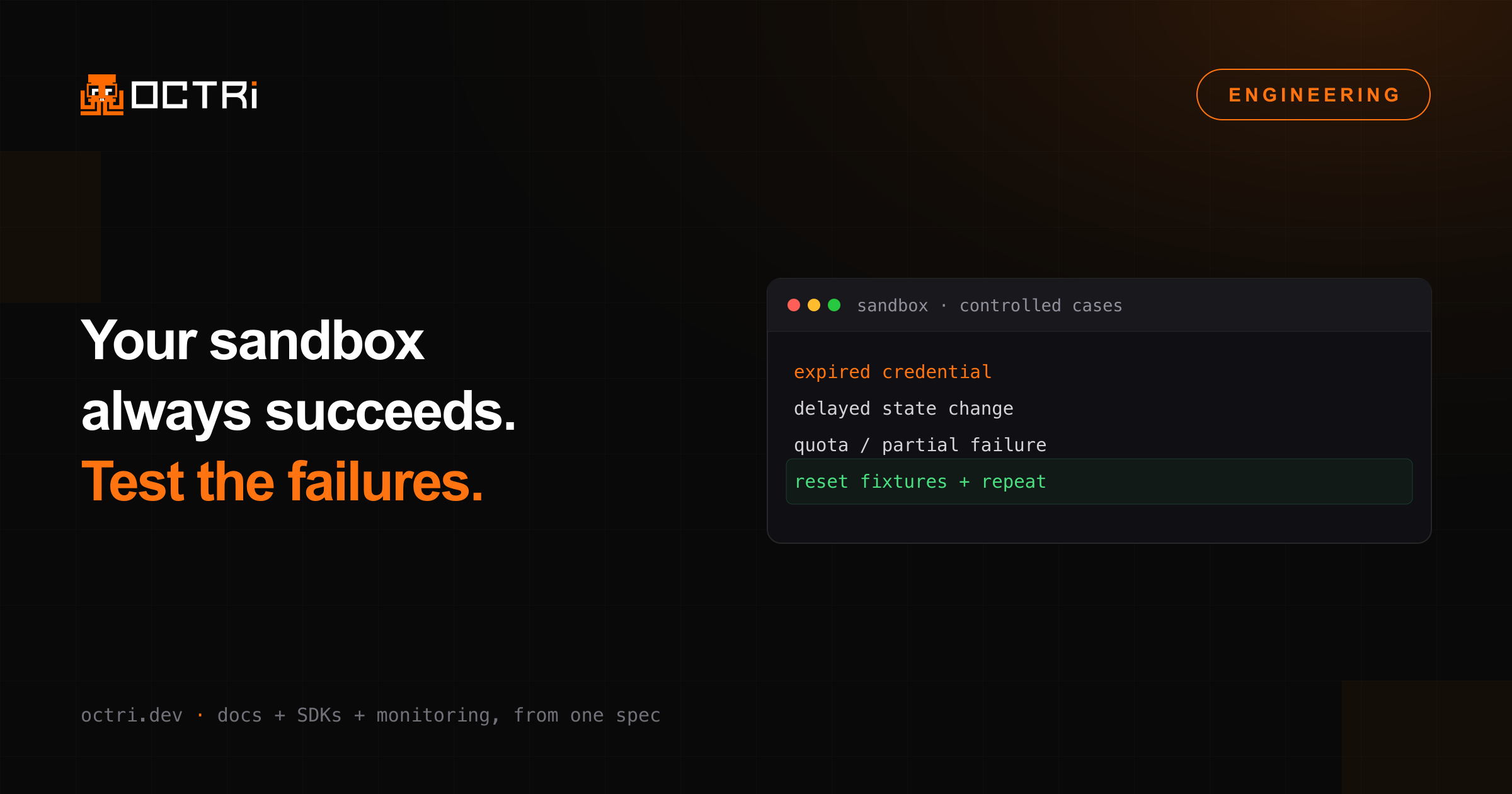
A sandbox accepts every valid request immediately. That is enough to demonstrate an endpoint. It gives an integration no practice with expired credentials, delayed results or partial failures.
Provide named scenarios that developers can trigger and repeat. Give each run its own test data and a reset procedure. Document which parts of production behavior the sandbox simulates.
Define what the sandbox represents
Document which behavior matches production and which behavior is simulated. State whether authentication, quotas, webhook delivery, asynchronous processing and consistency behave differently. A sandbox need not reproduce production infrastructure exactly to be useful, but its differences should be visible.
Stripe's sandbox documentation describes isolated testing environments and recommends separating different development and testing uses. Check each provider's isolation and configuration controls; they differ.
Use synthetic data and credentials that cannot operate on production resources. A sandbox name alone is not a security boundary if the underlying credentials or destination can still reach live systems.
Give failures stable triggers
Prefer documented scenario fixtures over random failure injection for onboarding examples. A known test account might represent an expired credential, a rejected operation or a delayed result. The specific mechanism is an application design choice; make it discoverable.
Include states customers must handle: no matching records, invalid permissions, quota exhaustion, conflict, partial processing and eventual completion. Return the same documented error shape that the corresponding production condition uses where feasible.
For timing-sensitive cases, offer a controlled way to advance state or observe transitions rather than making CI wait an arbitrary real-world delay. Explain which aspects are accelerated so consumers do not mistake test timing for a service-level promise.
Isolate simultaneous users
Separate fixture namespaces for local developers, CI jobs and agent attempts. One test should not change the credentials, account settings or data another test depends on. Make setup and cleanup idempotent where the API supports that behavior.
Publish a reset procedure and its scope. Does it delete only a test namespace, reset shared settings or invalidate credentials? Tests should not rely on a global reset that interrupts every developer using the environment.
Bound retained data and abandoned jobs. A failed automation run can leave resources behind even when its primary assertions passed. Give operators enough visibility to find those resources without exposing other users' test data.
Give each agent attempt its own fixtures
Agents benefit from a place to try real request sequences without affecting production. Give each attempt a clean starting state, restricted credentials, a request budget and an externally verifiable outcome.
Do not count success only because the agent received a positive response. Check the expected test resource and final state. Include tasks that require recognizing a documented failure and stopping rather than trying increasingly broad operations.
A deterministic environment helps distinguish a documentation problem from a model choice or an unavailable dependency. Retain sanitized traces and fixture versions so a failed task can be replayed.
Put the scenarios beside the reference
Give each scenario a short guide: prerequisites, request sequence, expected response, recovery behavior and cleanup. Keep identifiers visibly synthetic and explain how to select the correct environment.