components.securitySchemes is one of the most commonly skipped blocks in an OpenAPI document, and it is skipped for an understandable reason: the authors know how their API authenticates, so writing it down feels like paperwork.
It is not paperwork. It is the only input a generator has for building your client's auth. Leave it out and the SDK ships with no credential handling at all, and every one of your users writes their own header injection.
What each declaration becomes
The scheme is the contract. Here is what a generator does with each one.
apiKey. Becomes a configuration field and a header, query parameter or cookie, depending on in. The name matters: it is the actual header your client will send, so X-API-Key and Api-Key are different clients.
123456
components:
  securitySchemes:
    ApiKeyAuth:
      type: apiKey
      in: header
      name: X-API-Key
http with scheme: bearer. Becomes a token field and an Authorization: Bearer header. The most common case and the least ambiguous.
http with scheme: basic. Becomes a username and password pair, base64-encoded into Authorization: Basic by the client rather than by your users, which is the point.
oauth2. Becomes a token field and, more importantly, the flow declarations tell a reader where the token comes from. A generated client will send the token; the flows are what stop your users guessing which URL to post their credentials to.
Nothing at all. Becomes a client with no auth configuration. Your users construct requests correctly and get 401s, then read your prose docs, then hand-roll a header. Every one of them separately.
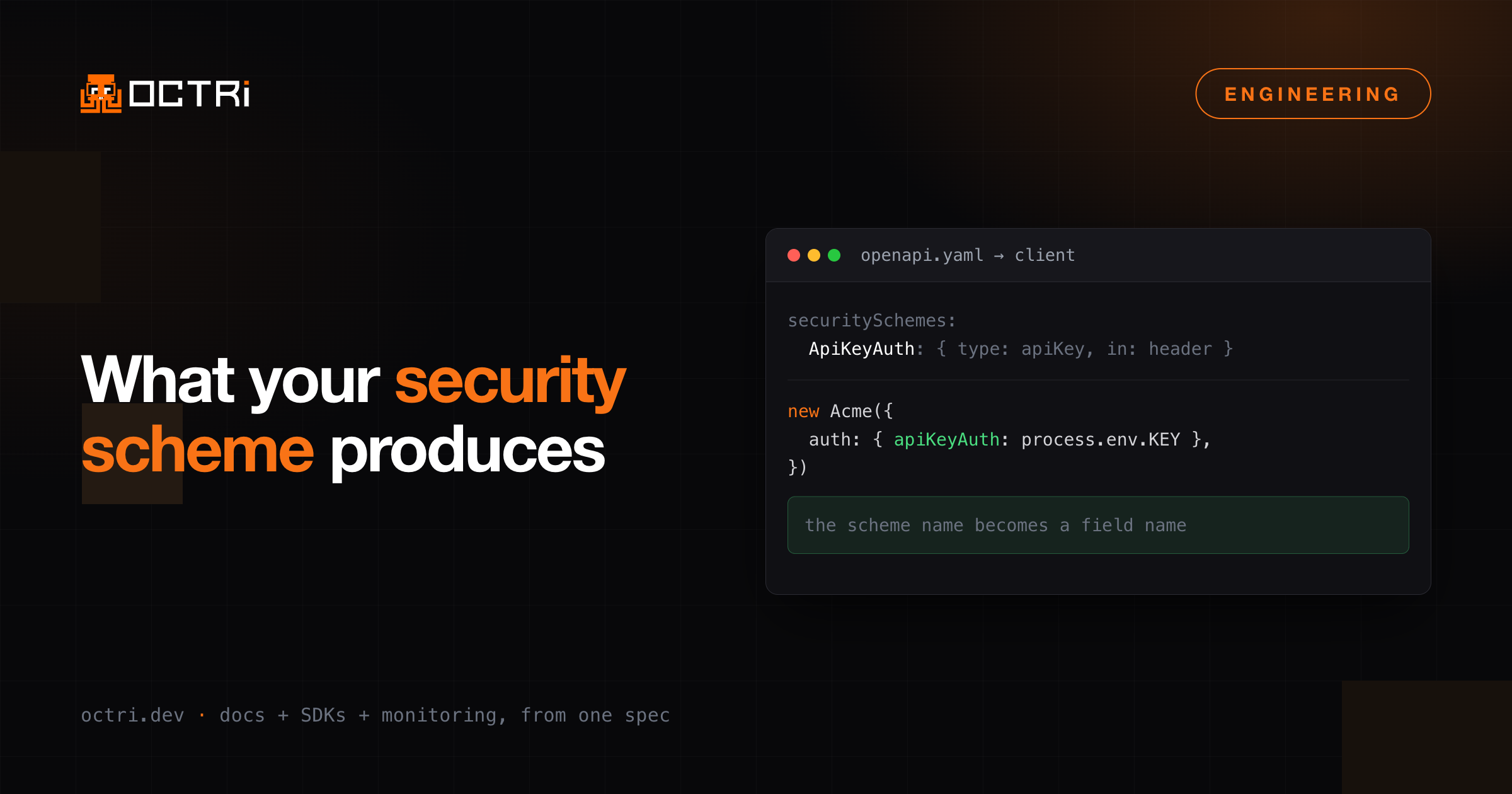
The name you choose becomes a field name
This is the part that surprises people. The key you give a scheme is not internal.
1234
components:
  securitySchemes:
    ApiKeyAuth:      # this name
      type: apiKey
That name propagates into the generated client's auth configuration as a field. Your users will type it:
1234
const acme = new Acme({
  baseUrl: "https://api.acme.com/v1",
  auth: { apiKeyAuth: process.env.ACME_KEY },
});
So ApiKeyAuth reads fine, auth1 does not, and SCHEME_A will haunt you. Name schemes the way you would name a public field, because that is what they are. And renaming one later renames a field your users have already written, which is a breaking change in a place nobody expects to find one.
Declaring a scheme is not the same as applying it
Two blocks, and specs routinely have one without the other.
components.securitySchemes declares that a scheme exists. security, either at the document root or on an individual operation, declares which operations require it. A document that declares a scheme and never applies it has told the generator that auth exists and never told it which calls need it.
1234567
security:
  - ApiKeyAuth: []          # applies to every operation

paths:
  /health:
    get:
      security: []          # except this one, explicitly public
That empty array on /health is worth knowing about. It is how you mark a single operation as public under a document-wide requirement, and without it your generated client will attach credentials to your health check and your docs playground will demand a key to call it.
Mixed auth is where it gets sharp
Plenty of real APIs use more than one scheme: a publishable key for browser calls, a secret key for server calls, sometimes a separate admin credential.
OpenAPI can express this. An array under security is OR, so any one of the listed schemes satisfies the requirement. Multiple keys inside a single array entry is AND, so both must be supplied.
123456789
security:
  - ApiKeyAuth: []          # either this
  - BearerAuth: []          # or this

# versus

security:
  - ApiKeyAuth: []
    BearerAuth: []          # both, together
Generated clients handle a declared multi-scheme setup far better than they handle an undeclared one. If your API genuinely has two credential types and your spec mentions one, the SDK gets built around the one, and the other becomes a support conversation about custom headers.
What we default to, and why it is not bearer
Worth stating plainly because it is a choice we get asked about.
An Octri project's SDK auth defaults to inherit, which means the generated client authenticates the way your spec's security scheme says it does. It does not default to bearer, even though bearer is the most common answer, because a project that has never opened SDK Studio should not have its SDK and its documentation playground quietly disagreeing about how to authenticate. One spec, one answer, in both places.
You can override it with a concrete scheme when the SDK genuinely needs to differ. The default is that it does not.
Keep credentials out of the client's constructor examples
A small documentation habit with a large blast radius.
Every code sample you publish is a template somebody will paste. If your sample shows a literal key, some fraction of your users will commit one. Read from the environment in every example, including the short ones:
1
auth: { bearerAuth: process.env.ACME_TOKEN }
Generated SDK readmes should do this by default. Your hand-written guides are where it slips.
Check what your spec currently declares
Undeclared auth is one of the fourteen rules our spec audit scores, and it is a cheap one to fix: the rule fires if components.securitySchemes is empty, which is a five-line edit for most APIs and changes what every generated client can do.
If you want to see the auth configuration a scheme produces at the call site, the OpenAPI to TypeScript SDK and OpenAPI to Python SDK pages show the constructed client in each language.