Measure your API docs by the first successful request
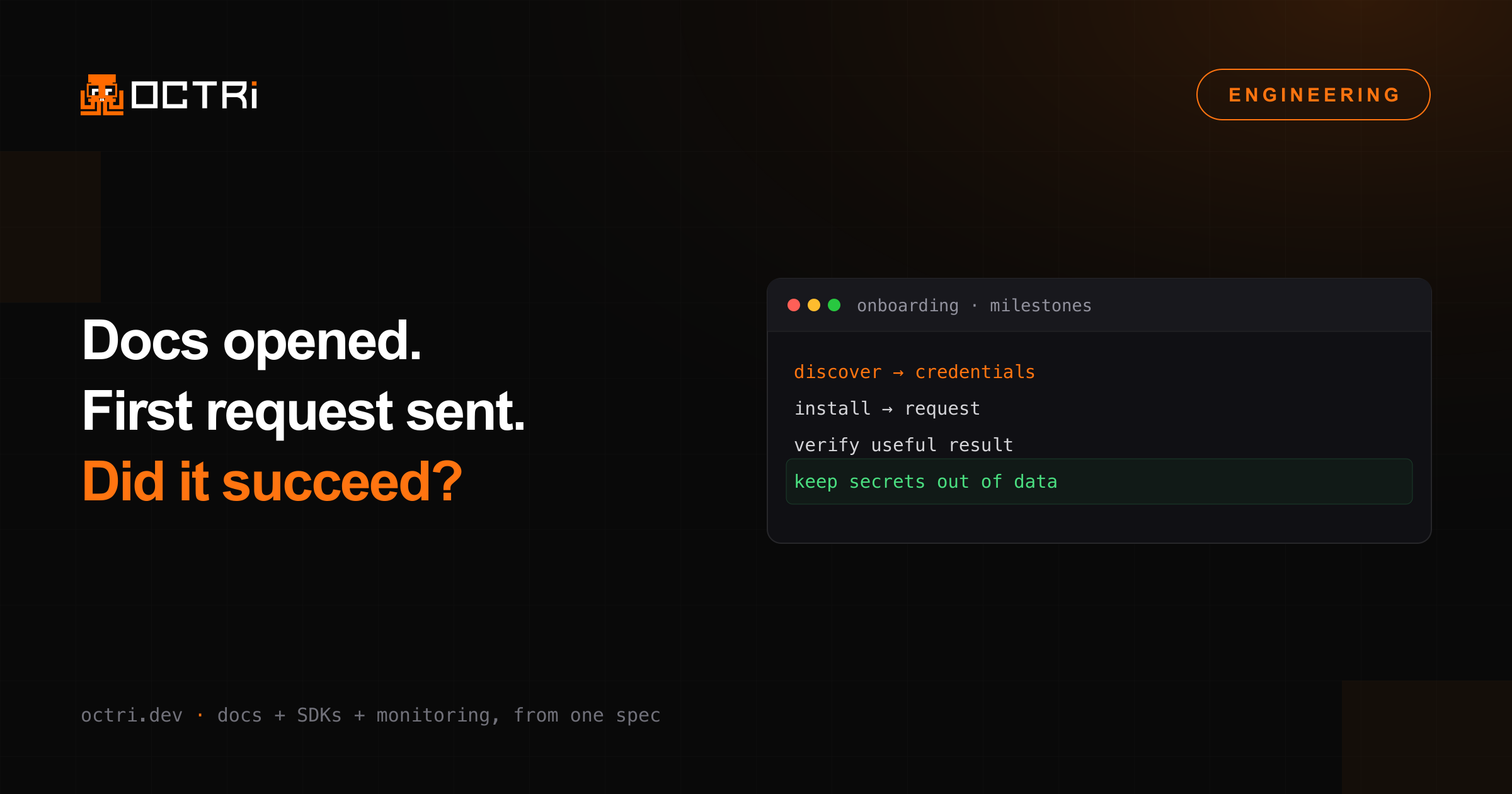
Follow onboarding from discovery to a verified result. Track completed steps and find where developers get stuck without collecting secrets or customer payloads.
A developer opens your quickstart, copies a command and leaves. Analytics records a visit and a copy-button click. Neither event tells you whether the command ran successfully or returned the result the developer needed.
Track the steps between opening the guide and receiving a verified result. A gap between credential creation and the first request calls for a different fix than a request that reaches the API and fails.
Define the beginning and the success
Postman describes time-to-first-call as an API onboarding metric. Before measuring it, decide where the clock starts and which request ends it.
Choose the start event: first documentation visit, account creation, project creation or the moment credentials become available. Those clocks answer different questions. Report which one you use instead of comparing unlike measurements.
Define a qualifying outcome. A successful health check may establish connectivity but not product understanding. For an export API, a useful first success might be creating and retrieving a small test export. For a search API, it might be receiving a valid result from a documented example dataset.
Observe milestones without recording secrets
Track guide discovery, environment selection, credential creation, SDK installation, the first request and result verification. Capture events that indicate those steps without copying API keys, authorization headers or customer payloads into analytics.
Some steps happen outside the browser. If server-side instrumentation can identify a qualifying sandbox request, use an appropriate correlation mechanism and privacy policy. If it cannot, distinguish an observed copy-button click from a verified API call. A proxy event is not evidence that a developer's local program worked.
Use aggregate cohorts or pseudonymous identifiers appropriate to the product. Keep collection aligned with user consent and retention policy. Onboarding measurement should not introduce a new repository of sensitive integration data.
Segment before interpreting averages
A returning customer with existing credentials and a first-time developer face different setup work. So do a browser user, a Python developer, a partner integrator and an agent-driven workflow.
Separate those cohorts when possible. Include unfinished journeys in funnel analysis rather than calculating a fast average from the users who succeeded. Report the observation window, sample size and chosen percentile or distribution.
Inspect where users pause. Credential creation may require an administrator. A package installation may fail because the runtime requirement is buried. An example may point at production while the account only has sandbox access. Each needs a different correction.
Use evidence to choose an edit
Combine milestone data with support questions and observed onboarding sessions. A high exit rate alone does not prove that a page is confusing; the visitor may have found the answer or been researching feasibility.
Make one specific improvement: move prerequisites earlier, state environment requirements beside the first example, explain how to obtain a scope, or show the expected result. Compare comparable cohorts over a stated window rather than attributing every change to the latest copy edit.
Agent journeys may need different evidence. Track whether the agent found current documentation, selected the intended SDK and produced a verified sandbox result. Do not treat an automated page fetch as a human onboarding session.
Link the quickstart to the version it uses
A reference describes operations in depth. A first-run guide takes the reader through one task. Link the guide to the exact reference and package version it uses, and keep the expected outcome visible.